Garage door technicians work with heavy, high-tension components that require the right tools to ensure safety, efficiency, and precision. From installation to maintenance, each task demands specific equipment to handle challenges like misalignment, spring tension, and electrical diagnostics. Here's a quick rundown of must-have tools and why they matter:
Key Takeaway: Equipped with proper tools, technicians can perform safer, faster, and higher-quality work while extending the lifespan of garage door systems.
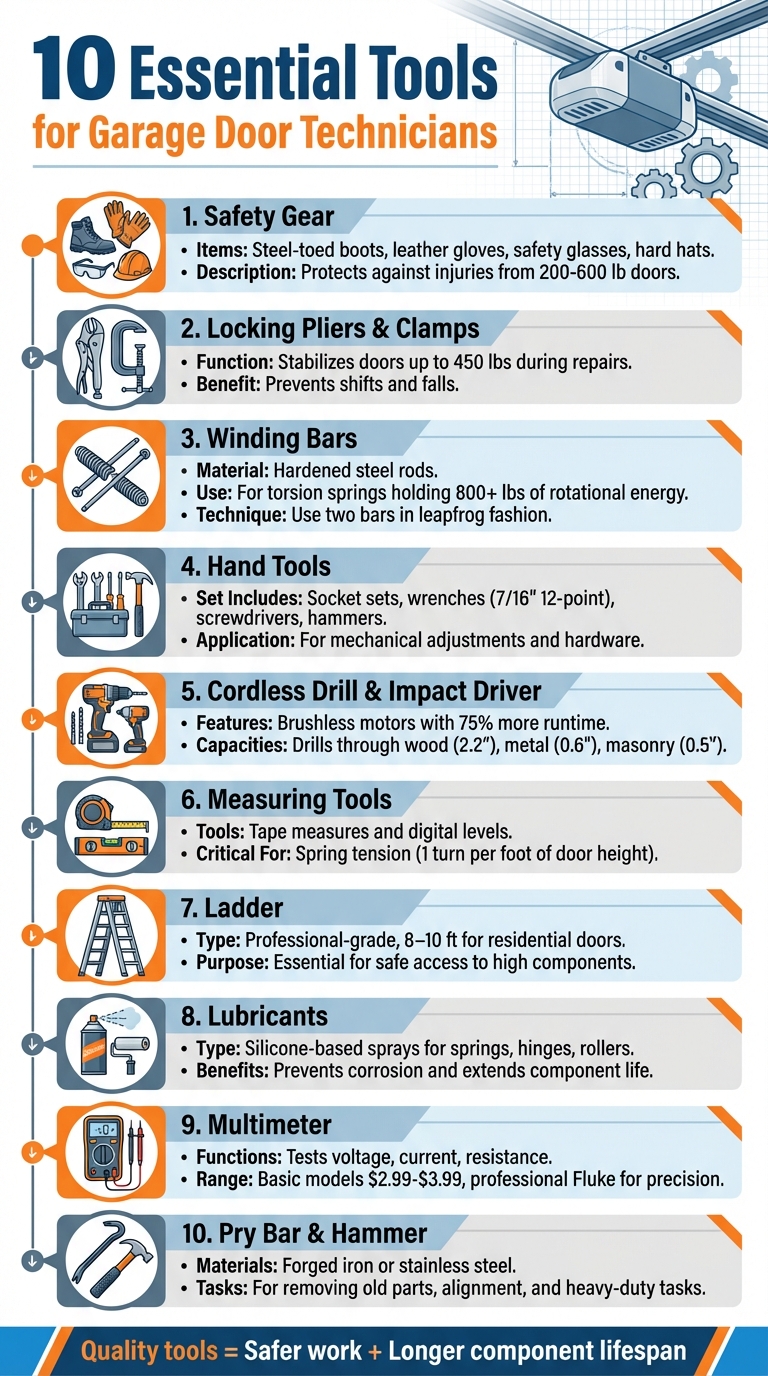
10 Essential Tools Every Garage Door Technician Needs
Garage Door Must Have Tool List
As ToolsDuty aptly states:
The tools don't just make the contractor - they protect the contractor, the customer, and the integrity of the task at hand.
So let's dive into the list and why each tool is so important:
1. Safety Gear
Working with garage doors can be dangerous. Mishandling heavy components or not taking proper precautions leads to hundreds of crushed finger injuries every year. That’s why using the right safety gear is a good idea. It’s absolutely necessary.
Steel-toed boots are a must when dealing with door sections that can weigh anywhere from 200 to 600 pounds. Look for boots made from leather, with high-traction soles and proper arch support to ensure stability.
Durable leather gloves are another essential. They protect your hands from sharp metal edges, provide grip for handling cables under tension, and shield against oil and grease. The trick is finding gloves that combine heavy-duty protection with enough flexibility for precise adjustments.
When working with high-tension springs, safety glasses or face shields are critical. If a spring snaps or a winding cone fails, flying debris can cause serious eye injuries. Make sure you wear them throughout the job. Similarly, hard hats protect your head from falling objects and accidental bumps into low beams or overhead components. As Smart Service puts it:
Brain injuries are no joke, so use your hard hat every time you could potentially have something fall on or fly at your head, when you're at risk of accidentally smacking into a protruding object like a low beam, or when you are at risk of falling.
Don’t forget to secure your hard hat with a chin strap to keep it in place during an impact or fall.
For loud power tools, hearing protection is essential to protect your ears. Respirators are also important, as they help shield your lungs from fine dust and fumes that can arise during tasks like cutting, drilling, or working in poorly ventilated areas. Additionally, thick, long-sleeved clothing provides an extra layer of defense against sparks from grinding or welding and helps reduce the risk of electrical hazards.
Before tackling any technical tasks, make sure you’re properly equipped with these safety essentials to prevent workplace accidents. They’re your best defense against the risks that come with garage door work.
2. Locking Pliers and Clamps
When working with garage door springs and cables, locking pliers and clamps are essential for ensuring stability and safety. These tools are what keep a garage door - sometimes weighing up to 450 pounds - from shifting or falling while you’re making adjustments to high-tension components.
Locking pliers and clamps are used to secure the door to its track or frame, especially when the springs are no longer supporting its weight. They're crucial for holding the door steady during extension-spring repairs and for stabilizing torsion tubes in single-spring systems. Just like safety gear, maintaining these tools is vital for safe and effective operation.
For most garage door tasks, curved jaw locking pliers - often called Vise-Grips - are the go-to choice. A 10-inch curved jaw model, priced around $33.60, is a popular option in the industry. It’s recommended to use at least two locking pliers to keep the door level and securely in place.
Always replace tools that show signs of wear or a weakened grip, as these are your first line of defense against accidents. To keep your tools in top condition, lightly oil moving parts to prevent rust without attracting debris. For added comfort and control during high-torque tasks, look for models with rubber-grip handles.
3. Winding Bars
Winding bars are essential tools for safely adjusting garage door torsion springs. These hardened steel rods are specifically designed to handle the immense energy stored in the springs. For example, the torsion springs on a standard 7-foot garage door can hold around 800 lbs of rotational energy. As described in the Garage Door Handbook:
Torsion springs work like coiled cobras, harmless when properly restrained, deadly when provoked .
Using improper tools like screwdrivers or pliers can lead to dangerous slippage and injuries. It’s critical to ensure the winding bar’s diameter matches the winding cone openings exactly to prevent damage or accidents. DDM Garage Doors emphasizes:
Failure to use a tight-fitting winding bar in a winding cone may result in the destruction of the cone, personal injury, or even death.
When working with torsion springs, always use two winding bars in a leapfrog fashion, turning the spring a quarter-turn at a time. Never remove one bar until the other is securely in place. Residential winding bars, typically 18 inches long, cost between $16.80 and $23.41, while commercial options ranging from 24 to 36 inches are priced at $29.08 to $40.63. Longer bars provide the extra leverage needed for higher-tension doors.
It’s a good idea to have multiple sets of winding bars to accommodate different winding cone diameters, such as 7/16 inch, 1/2 inch, or 5/8 inch, depending on the manufacturer. Some bars feature a hexagonal grip to prevent rolling, making spring adjustments faster and safer. Regular inspections are also vital - look for signs of wear or bending, as a damaged bar may not fit securely and could pose a serious risk.
4. Hand Tools
Basic hand tools are just as important as specialized safety and high-tension tools when it comes to making precise mechanical adjustments. For garage door technicians, these tools are essential for securing track systems, hinges, and other hardware.
Socket sets and ratchets play a key role in tightening bolts on track brackets, cable drums, and spring anchors. A 7/16-inch 12-point wrench is particularly useful for handling winding cone locking bolts. Meanwhile, adjustable wrenches offer flexibility, especially in tight spots around headers and tracks.
Screwdrivers are another must-have. Both Phillips and flat-head screwdrivers are used for tasks like removing panels, servicing motors, and adjusting hinges. As Smart Service explains:
Set screws hold winding cones in place, so you will need a set of screwdrivers for each technician. They may also need to remove panels, remove hinges, or remove the track.
Screwdriver sets are affordable, starting at around $10, while a 1/4-inch nut driver costs roughly $12.61.
Locking pliers (commonly known as Vise-Grips) are indispensable for anchoring the torsion shaft during adjustments. Needle-nose pliers are equally important for bending cable ends to fit into drum slots.
Additional tools include a hammer for alignment tasks, a file for smoothing burrs and set screws, and hex keys for making hardware adjustments. Over-tightened set screws can distort the shaft, which makes a file an everyday necessity for technicians.
DDM Garage Doors emphasizes:
Never touch a set screw without first inserting a properly fitting bar into the winding cone! Also, do not use box or socket wrenches for the set screws [if the cone is under tension].
When used correctly, these hand tools not only improve precision but also ensure safe and secure installations, boosting the quality of service provided by technicians.
5. Cordless Drill and Impact Driver
While safety gear ensures protection and precision tools handle the finer details, cordless drills and impact drivers are all about boosting efficiency. These tools are essential for speeding up garage door installations and repairs. They make quick work of driving screws into tracks, hinges, and panels, and can drill pilot holes through wood, metal, and masonry. For context, a drill can handle wood up to 2.2 inches thick, metal up to 0.6 inches, and masonry up to 0.5 inches.
The type of motor matters, too. Brushless motors are a game-changer, offering up to 75% more runtime compared to older 18V NiCad brushed motors. For garage door projects, a 3-speed transmission is incredibly useful. It allows technicians to adjust torque and speed depending on the task - whether it's drilling pilot holes in wooden frames or driving heavy lag screws into concrete. Plus, a 1/2-inch ratcheting nitro-carburized metal chuck with carbide inserts ensures the bit stays firmly in place, even during high-torque applications.
Battery performance is just as important as motor power on a busy job site. High-capacity lithium-ion batteries (5 Ah or higher) are a solid choice, and keeping fully charged backups on hand helps avoid unnecessary downtime.
Lighting is another feature worth considering. Integrated LED work lights in modern drills are up to 20 times brighter than older versions. Many now include spotlight modes and a 20-minute auto-shutoff feature, making them incredibly handy for working in dimly lit garage corners or during power outages.
Lastly, regular maintenance keeps these tools in top shape. Cleaning, oiling moving parts, and checking for wear and tear go a long way in extending the lifespan of your drill or impact driver while reducing the risk of on-site breakdowns.
6. Tape Measure and Level
Accurate measurements and proper alignment are key to avoiding costly mistakes and safety risks, especially when dealing with doors that can weigh up to 450 pounds. Even a slight misalignment can strain an opener’s gears, sprockets, and bearings, while incorrect spring measurements can lead to dangerous imbalances. These measurements form the foundation for the techniques outlined here.
When determining spring wire size, technicians rely on a 20-coil measurement, taken to the nearest 1/16-inch using a gauge chart. This approach is far more dependable than calipers, which can be affected by factors like rust, paint, or the coil’s natural curve. Interestingly, about 30% of manufacturers and service companies mix wire sizes on doors with two springs, so it's essential to measure each spring individually rather than assuming they match.
Precise spring measurements are crucial for setting the correct tension. The general rule is one full turn of tension for every foot of door height - so a 7-foot door typically requires 7 to 7.5 turns. Additionally, technicians account for "spring growth", as torsion springs elongate by one coil per full turn. Measuring the cable drum circumference further fine-tunes these calculations.
For alignment, digital levels outperform traditional spirit levels, offering greater precision. Properly aligned tracks and headers reduce friction and noise, ensuring smoother door operation.
Even small details, like how you use a tape measure, matter. The slotted hook at the end offsets the tape’s thickness, so pushing the tape into a surface instead of hooking it can result in a 1/16-inch error. Paying attention to these finer points separates technicians who deliver consistently high-quality work from those who face frequent issues.
7. Ladder
When it comes to garage door installations and repairs, having the right ladder is a must. A professional-grade ladder ensures safe access to ceiling-mounted openers, torsion springs, and upper track sections. As DDM Garage Doors wisely notes, "Stand securely on a sturdy ladder, not on chairs or cans turned upside down." Makeshift platforms might seem convenient, but they significantly increase the risk of falls or serious injuries, especially when working with high-tension components.
For residential garage doors, which are typically 7 to 8 feet tall, you'll need a ladder that can safely extend to 8 to 10 feet, while also supporting heavy loads. Keep in mind, older garage doors can weigh as much as 450 pounds. For service teams, having at least two sturdy ladders on-site is a smart move. This is particularly important for jobs requiring multiple technicians to hold the door level during installations or spring replacements.
Proper ladder placement is just as important as the ladder itself. Position your ladder to the side of the spring ends rather than directly in front of the winding cones. This reduces the risk of injury if a tool slips during high-torque tasks. Before testing the door's balance, step off the ladder and move it aside. Secure the door by using locking pliers or C-clamps on the tracks above the rollers. These small but essential precautions go a long way in keeping your workspace safe.
A good ladder allows you to reach high spots safely and securely, preventing falls and ensuring you can work comfortably. Consider using a multi-position or extension ladder for added versatility, and make it a habit to inspect your ladder regularly for wear or damage. When you're dealing with high-tension components, the last thing you want is equipment failure. Combining the right tools with careful preparation keeps you safe and efficient on every job.
8. Lubricants and Maintenance Supplies
Keeping your garage door system in good shape starts with regular lubrication. This simple step helps prevent corrosion and reduces wear on the opener motor, saving you from costly repairs down the road. Having the right lubricants and cleaning supplies on hand allows you to tackle minor issues before they escalate. Plus, proper maintenance extends the life of your door’s components and ensures smooth operation.
When it comes to lubricants, choose ones designed for the specific needs of moving parts. Silicone-based spray lubricants are ideal for springs, hinges, and roller bearings because they provide lasting protection and resist dirt buildup. On the other hand, white lithium grease can clump over time, and products like WD-40 or mineral oils often attract grime and lack durability. High-quality options, such as Blaster or Clopay Garage Door Pro Lube, are budget-friendly at under $8 per can. For heavier applications, consider Lubriplate Aero Multi-Purpose Grease, which costs $15.14 for a 1 3/4 oz tube.
Before applying lubricant, make sure the components are clean. Use a damp rag to wipe away dirt, and for rusted or corroded tracks, a wire brush works wonders. If you’re dealing with stubborn grime, brake cleaner can help - just wipe it off with a dry cloth afterward. Protect surrounding surfaces from overspray with rags or cardboard. However, never lubricate the tracks themselves, as Sean Donnelly advises:
We don't recommend lubricating garage door tracks in most cases; lubricant used for this can attract dirt, which can affect long-term operation .
How often you should lubricate depends on where you live. In mild, dry climates, every six months should suffice. But if you’re in a coastal or high-salinity area, plan to lubricate every four months. Chain-drive openers, which experience more friction than belt or direct-drive systems, also need regular rail lubrication.
Don’t forget to include other essentials in your maintenance kit, like batteries, light bulbs, wood filler, and silicone caulk ($17.95 for a 9.8 oz tube).
Spending $8 on a can of lubricant every few months is a small price to pay compared to replacing rollers or hinges ($75–$150) or even the entire garage door, which can cost over $2,700. Regular upkeep not only saves money but also keeps your garage door running smoothly for years to come.
9. Multimeter
A multimeter is an essential tool for ensuring garage door systems' electrical components work safely and efficiently. It’s a go-to device for diagnosing electrical issues, measuring voltage, current, and resistance. Basic digital models are budget-friendly, priced between $2.99 and $3.99, while professional-grade options, like those from Fluke, deliver greater precision and reliability.
One of the key uses of a multimeter is performing a continuity check. This test identifies breaks in wiring or blown fuses. A successful continuity test produces a near-zero ohm reading and a beep, while an "O.L." reading signals a break in the connection.
Voltage testing is another critical function. Use it to confirm 120V AC at outlets or verify proper DC voltage at sensor circuits. Resistance measurements can uncover issues like dirty connectors or corrosion. I just make sure the circuit is powered off before performing resistance checks. When measuring current in an unfamiliar circuit, start with the highest setting (often 10A) to avoid damaging the meter’s internal fuse.
For garage door openers with variable-speed motors, a True-RMS multimeter is necessary to accurately measure non-sinusoidal waveforms. High-end models can also test capacitors and check the charge of remote control batteries.
Always test your multimeter on a known live source before and after diagnosing a system to ensure accurate readings. To measure voltage, connect the probes across two points. For current, insert the meter directly into the circuit. These steps help maintain accuracy and prevent errors during troubleshooting.
10. Pry Bar and Hammer
Pry bars and hammers are must-have tools for garage door repairs. Whether you're removing old hardware, aligning parts, or installing new components, these tools handle the heavy lifting. They work hand-in-hand with precision tools to round out your garage door repair kit.
For general tasks, a standard claw hammer is your go-to. When working with delicate surfaces, opt for a rubber mallet to avoid damage. For specialized tasks involving garage door components, a torsion shaft hammer is the right choice. For example, when replacing springs, lightly tap the winding bar to stretch the spring about 1/4 inch before tightening the setscrews.
Durability matters, so choose forged iron or stainless steel tools with ergonomic grips. These materials stand up to heavy use while reducing hand strain. As the best garage door companies will tell you, you always prioritize quality tools to ensure the safety, functionality, and longevity of the garage door system .
When working near sensitive parts, apply controlled force. Overstriking the torsion tube, for instance, can cause punctures or distortions. Use the pry bar carefully to adjust misaligned parts, and secure the door with C-clamps to prevent unexpected movement during repairs.
After every job, clean and inspect your hammers and pry bars. Look for grease, debris, or signs of wear like cracks or rust. Keep wood filler handy for fixing minor frame damage. Regular maintenance ensures your tools stay reliable and safe for the next project.
Conclusion
The right tools are key to safe and efficient work for garage door technicians.
Working with high-tension components requires reliable, well-maintained equipment. A solid foundation of quality tools not only supports effective repairs but also ensures proper maintenance practices.
Investing in quality tools directly impacts service quality and the lifespan of components. Precision tools help maintain proper balance and extend the life of garage doors. Diagnostic devices, like multimeters, save time during troubleshooting and reduce unnecessary parts replacement. Even basic tools, such as worm drive jacks, protect customer property by allowing careful handling of heavy components.
Caring for your tools is just as important as owning them. Regular cleaning, oiling, and calibration help prevent wear and tear, ensuring tools perform at their best. Damaged tools should be replaced immediately to uphold safety standards.
Stay ahead by updating your toolkit with modern technologies. Advanced tools like cable tension monitors and laser measures improve accuracy on complex jobs, while safety features such as extension spring containment cables provide added protection. Stocking your service van with various essential tools - like 1/2-inch and 7/16-inch winding bars and the right clamps - ensures you're prepared for any situation. Embracing these innovations demonstrates a commitment to top-notch service.
A well-maintained toolkit is a reflection of your professionalism and dedication to safety. By investing in high-quality tools and maintaining them with care, you'll be equipped to tackle every job confidently while safeguarding both yourself and your customers.
FAQs
What safety tools are essential for garage door technicians?
Garage door technicians encounter various risks on the job, making safety tools and equipment a must-have. Essential personal protective equipment (PPE) includes durable gloves to guard against cuts and abrasions, safety goggles or a face shield to protect eyes and face from flying debris, and steel-toed boots to safeguard feet from heavy components. A hard hat is also essential, offering added protection when working under doors that could unexpectedly fall.
Beyond PPE, specific tools play a vital role in ensuring safety. Locking pliers or C-clamps are indispensable for securing doors during adjustments, keeping them from moving accidentally. Sturdy winding bars are another critical tool, allowing technicians to safely handle the tensioning or release of high-tension springs. Paired with proper lifting techniques and teamwork, these tools help minimize the risk of workplace injuries.
Why are winding bars essential for safely adjusting torsion springs?
Winding bars are essential tools for safely adjusting torsion springs, allowing technicians to manage the spring's tension without directly touching the coil. By inserting the bar into the slots of the winding cone, the energy stored in the spring is transferred to the bar instead of the technician's hands, keeping them at a safe distance.
These bars typically range from 18 to 36 inches in length, offering the leverage needed to wind or unwind the spring with less effort while maintaining precise control. A well-fitted winding bar also minimizes the risk of slipping, which could cause a sudden and dangerous release of the spring. This makes them critical for ensuring safety during torsion spring adjustments.
Why is it important to maintain garage door tools regularly?
Regularly maintaining garage door tools is essential for keeping them safe, dependable, and ready for any task. Tools like torsion spring winding bars, cable tensioners, and diagnostic meters benefit greatly from routine inspections, cleaning, and calibration. This proactive care helps prevent unexpected failures, reducing the chances of accidents or damage to the garage door system.
Taking care of your tools also boosts efficiency. For example, lubricated moving parts and properly tensioned springs allow technicians to work more quickly and accurately. Plus, regular maintenance extends the life of your tools, cutting down on expensive replacements. This not only saves time and money but also ensures technicians can deliver top-notch service to their customers.