The home services industry has officially crossed into trillion-dollar territory, and the contractors paying attention to the statistics are the ones quietly running away with market share.
If 2024 was the year homeowners stopped moving and started renovating, 2025 was the year AI quietly walked through every back office in America. From plumbing shops in Tulsa to landscaping crews in Tampa, the contractors using technology to capture more leads, retain more customers, and outwork the labor shortage are pulling ahead. The ones still running 2016 playbooks are watching their margins compress.
This article pulls together the freshest 2025 and 2026 statistics on the U.S. home services industry. We cover market growth, the labor crisis, AI and smart home adoption, marketing and lead conversion, generational customer preferences, revenue trends, and customer retention. Every stat is sourced and linked so you can verify and dig deeper.
Let's get into it.
The Growth of the Home Services Industry
Home services aren't just growing, they're consolidating, professionalizing, and pulling in serious institutional capital. You can check out our Field Service News for all types of mergers and acquisitions. Here's what the numbers say about where the market stands in 2026.
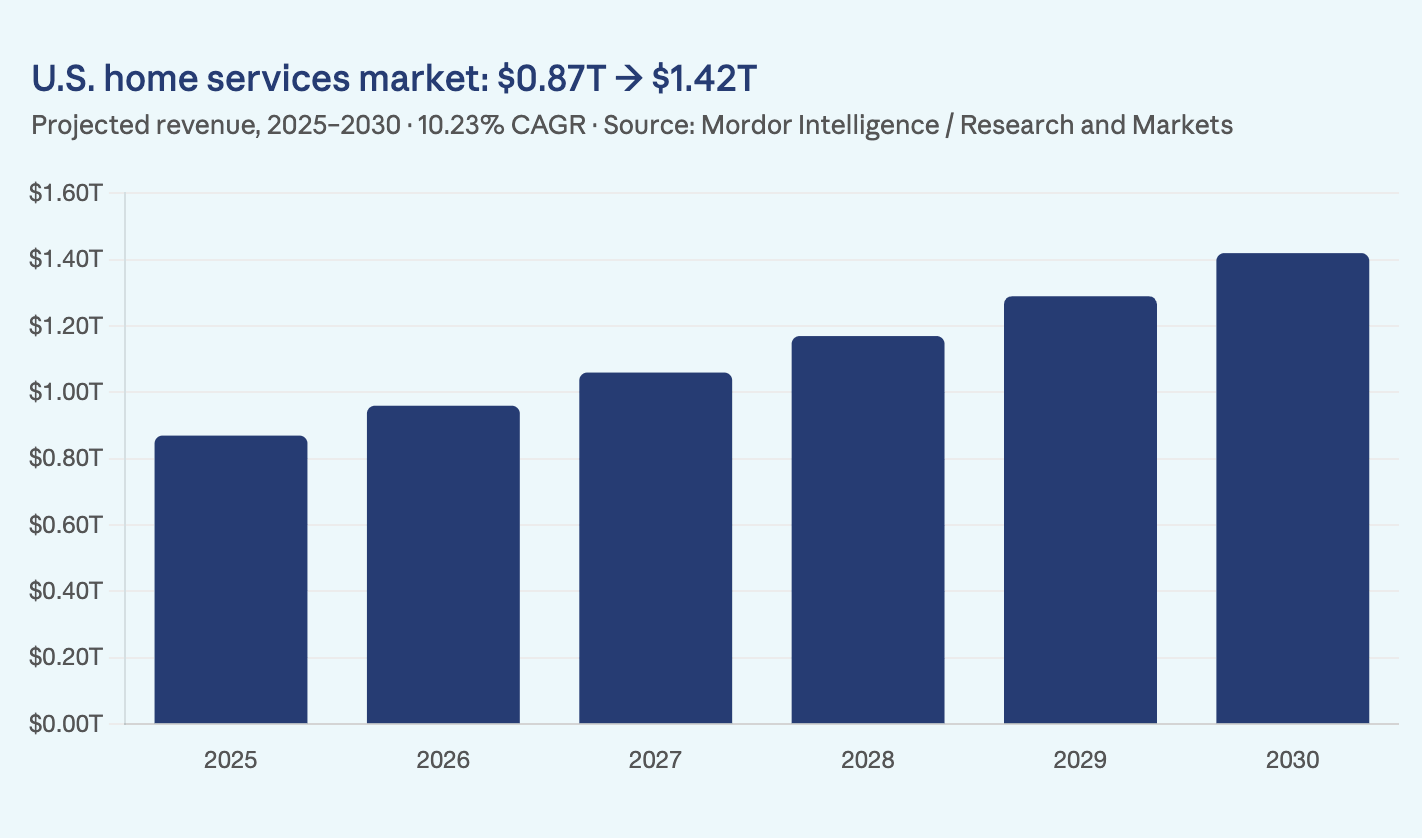
1. The U.S. home services market hit $0.87 trillion in 2025 and is forecast to reach $1.42 trillion by 2030. That’s a 10.23% CAGR. Multiple sources say we’ve already hit the $1trillion mark. That's faster growth than most developed-economy industries, fueled by aging housing stock and a homeownership base that keeps choosing renovation over relocation. (Research and Markets and Mordoor linked in #3)
2. Annual homeowner spending on improvements and maintenance was projected to hit a record $526 billion by the first quarter of 2026. Even with activity easing from the 2022 peak, the remodeling market continues to demonstrate remarkable resilience. Harvard's Joint Center for Housing Studies tracks this as one of the most stable housing-adjacent markets in the country. (Harvard JCHS Leading Indicator of Remodeling Activity)
3. Maintenance and repair captured 37.82% of all U.S. home service revenue in 2025. This is the largest single segment of the entire industry. As 44% of American homes were built before 1970, that share isn't going anywhere. (Mordor Intelligence)
4. The South captured 34.73% of the U.S. home service market in 2025, while the West is forecast to grow fastest at a 3.92% CAGR through 2031. Storm-driven repairs in the South and energy-efficiency upgrades in the West are reshaping where the dollars flow. (Mordor Intelligence)
5. Over 60% of the top 50 home service companies are now private-equity backed. PE rollups have created a bifurcated market. Large consolidated platforms with institutional capital on one side, independent contractors on the other. The "middle ground" of regional $10–50M companies is where the M&A heat is concentrated. (Lightning Path Partners)
6. The Inflation Reduction Act allocated $8.8 billion to the DOE's Home Energy Rebate programs, funding heat-pump, insulation, electrification, and whole-home efficiency upgrades. Federal rebates for HVAC, insulation, and plumbing upgrades have become a structural tailwind for the trades, particularly for contractors certified to handle compliance work. (U.S. Department of Energy)
Labor and Workforce Statistics
The labor shortage is no longer cyclical; it's structural. And it's hitting every trade simultaneously.
Plumbers, Electricians, and HVAC
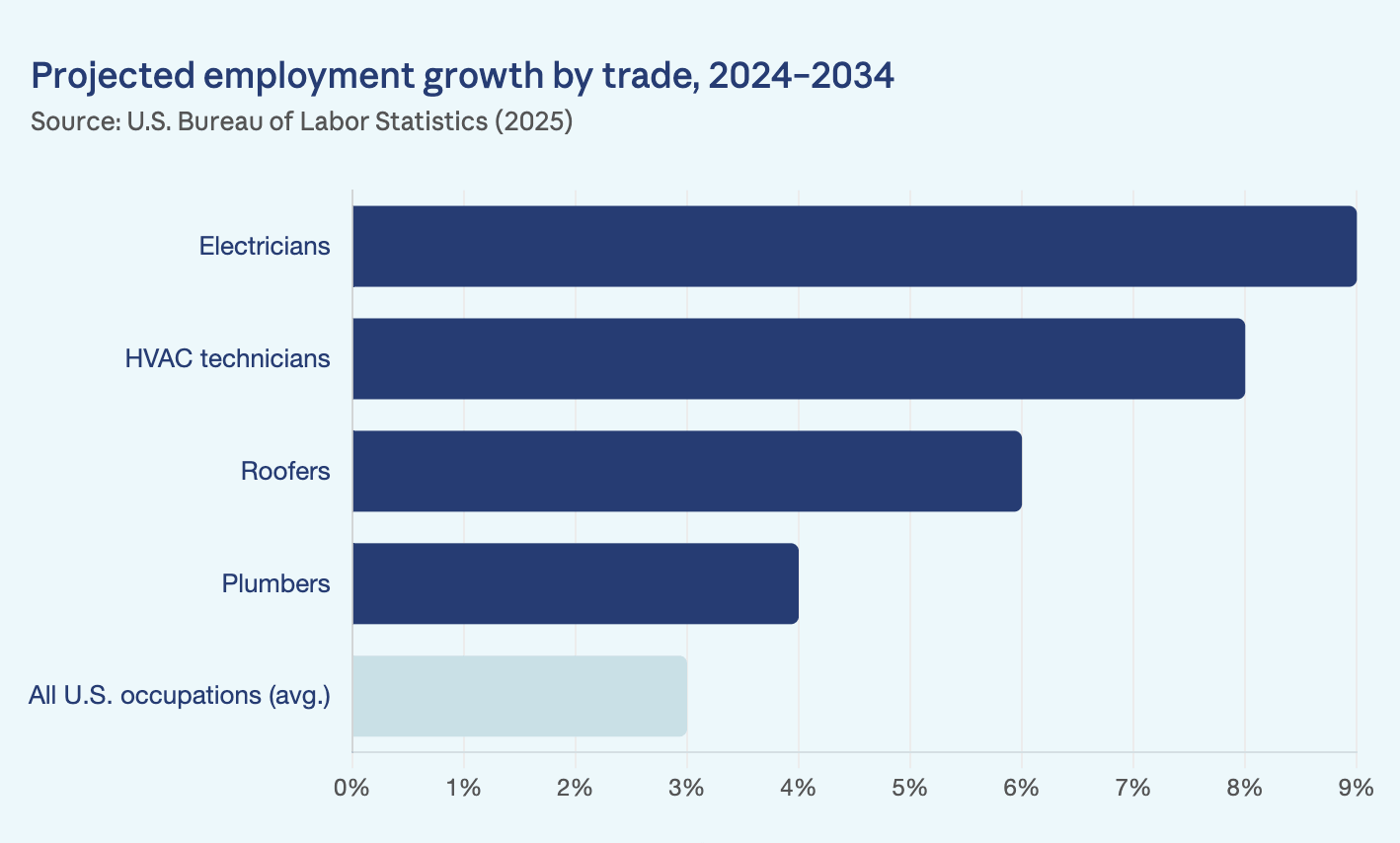
7. The Bureau of Labor Statistics projects 81,000 electrician job openings, on average, each year through 2034, with employment growth of 9% which is classified as "much faster than average." Data center construction, EV charging infrastructure, and grid modernization are driving the surge. (U.S. Bureau of Labor Statistics)
8. HVAC mechanic and installer employment is projected to grow 8% through 2034, adding 40,100 openings per year, on average. Heat pump adoption, energy-efficiency mandates, and building electrification are all converging on a labor pool that can't keep up. (U.S. Bureau of Labor Statistics)
9. The HVAC technician shortage was expected to reach 225,000 unfilled roles in 2025. This single trade represents the most acute mid-decade workforce gap in the residential sector. That gap number is likely to increase in the coming years. (Contractor Accelerator)
10. The median plumber wage in 2024 reached $62,820, with the top 25% earning over $81,740. Construction wages grew 4.2% year-over-year through mid-2025, outpacing the national average. This appears to be a direct consequence of how scarce qualified workers have become. (NAHB Construction Labor Report)
11. 92% of construction firms report difficulty finding qualified workers, and the industry needed 439,000 new workers last year (in 2025), and will need 499,000 in 2026. (Fixr.com)
The Aging Workforce
12. 41% of the current construction workforce will retire by 2031, according to the National Center for Construction Education and Research. More than 20% of construction workers are already over 55, taking decades of institutional knowledge with them. (NCCER via Contractor Accelerator)
13. 39% of U.S. facilities managers are over 55, compared to 28% across all occupations. Paul Morgan, JLL’s global COO calls this aging workforce a "silent army." Invisible, indispensable, and disappearing faster than it can be replaced. (Fortune)
14. The skilled labor shortage cost the U.S. residential construction industry an estimated $8.1 billion in lost output in 2024. That was the equivalent of 19,000 single-family homes never built. (Home Builders Institute via ADP Research)
Landscaping and Lawn Care
15. The U.S. landscaping services industry hit $188.8 billion in 2025, growing at a 6.5% five-year CAGR. The industry employs more than 1.4 million people across 692,777 businesses making it the third-largest sector under Administration, Business Support, and Waste Management Services. (NALP / IBISWorld)
16. 51% of landscaping companies identify staffing as a major risk, and 55% are raising wages by 2-9% to attract and retain talent. Despite the heat on labor, industry profitability held resilient at 11.9% in 2025, but only for operators who've invested in route optimization and crew efficiency. (Aspire Landscape Industry Report)
Roofers
17. The U.S. roofing contractor industry reached $76.4 billion in revenue in 2025, with 156,800 roofers employed across more than 100,000 businesses. Employment growth is projected at 6% through 2034, faster than average. This is driven largely by replacement demand from extreme weather. (This Old House)
18. 1 in 5 roofers is now over 55, putting the trade among the most heavily exposed to retirement risk. And Florida employs the most roofers of any U.S. state, which also happens to be where people like to retire to. (Local Roofing SEO Agency)
Painters
19. The U.S. Painters industry generated $49.0 billion in revenue in 2025, with the House Painting & Decorating Contractors segment specifically clocking in at $28.2 billion across 223,000 small businesses, a fragmented market where no single firm holds more than 5% share. (IBISWorld)
Cleaning Services
20. The global cleaning services market is expected to reach $481.75 billion in 2026 and is projected to nearly double to $859.20 billion by 2034, growing at a 7.50% CAGR. North America leads with a 37.52% share, anchored by post-pandemic hygiene demand and dual-income household growth. (Fortune Business Insights)
21. 73% of consumers prefer green cleaning solutions, and 68% are willing to pay more for sustainable services. The eco-friendly cleaning segment alone is projected to surpass $11 billion, a 30% slice of the total cleaning industry. (RMS Cleaning / American Cleaning Institute)
Epoxy and Concrete Coatings
22. The global concrete floor coatings market was valued at $5.2–$5.7 billion in 2025, projected to reach $9.5 billion by 2035 at a 6.2% CAGR. Epoxy alone holds 49.7% market share. Residential garages, warehouses, and commercial floors demand chemical resistance and durability. (Market.us / Future Market Insights)
General Contractors
23. Construction wages in the residential sector rose 9.2% year-over-year in mid-2025, more than 3x the rate for white-collar workers and far above inflation. This is direct evidence that the trades are bidding up wages to fill open roles. (NAHB Construction Labor Report)
24. 33% of recent U.S. high school graduates would advocate enrolling in trade school, edging out the 28% who'd advocate for a four-year college, a generational shift in attitudes toward four-year college that's finally reaching the trades. Trade school enrollments among Gen Z have surged 1,421% over the past eight years. (Fortune / American Staffing Association)
Technology in Home Services: AI, Robotics, IoT, and Smart Home Products
The most surprising shift of the past year wasn't in the field though, it was in the office. Contractors are quietly adopting AI tools for admin, marketing, and customer service at rates that would have seemed unthinkable two years ago.
AI Adoption in the Trades
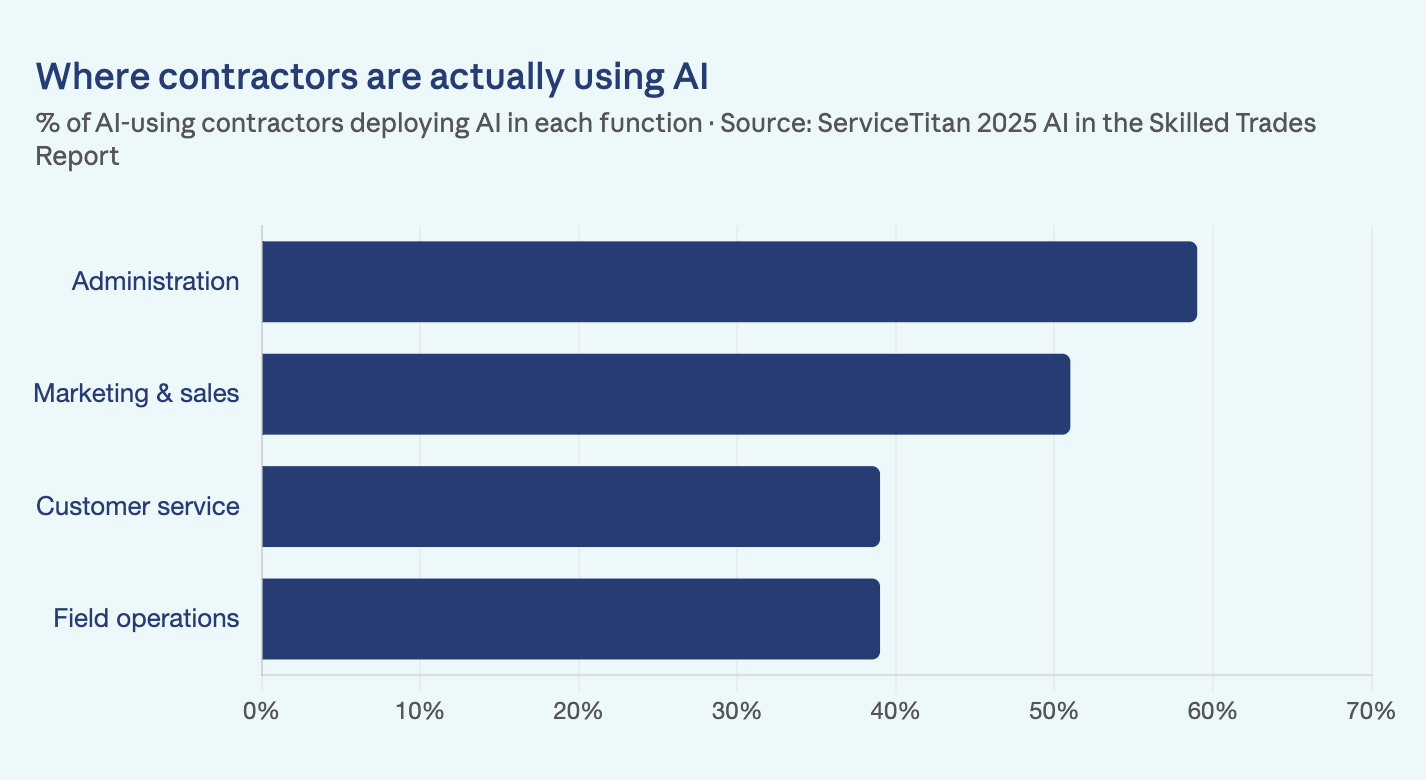
25. 46% of contractors are already using or experimenting with AI, according to ServiceTitan's inaugural AI in the Skilled Trades Report. Among adopters, AI is most commonly deployed for administration (59%), marketing and sales (51%), and customer service plus field operations (39% each). (ServiceTitan Press Release, research conducted by Thrive Analytics)
26. Over 70% of home service contractors have tried AI tools, and roughly 40% are using AI actively in their businesses. 80%+ of those adopters say the tools met or exceeded their expectations. (PM Mag ref. Housecall Pro AI Adoption Report)
27. AI adopters reclaim more than 4 hours per week from admin tasks. That includes tasks like writing emails, doing data entry, running follow-ups. For a plumber or electrician, those four hours typically convert to additional service calls or unpaid family time recovered. (PM Mag ref. Housecall Pro AI Adoption Report)
28. 57% of AI-using contractors say it has helped their business grow, primarily through faster lead capture (never missing a call) and AI-generated marketing reach. 54% of business owners under 35 are already using AI, roughly twice the rate of those over 65. (PM Mag ref. Housecall Pro AI Adoption Report)
29. 85% of field service leaders say their AI investments will increase over the next year, and AI-led customer service conversations grew 22x in the first half of 2025. Contractors who delay implementation in 2026 will face a compounding disadvantage as competitors close more jobs per technician with the same headcount. (Salesforce State of Service Report)
30. Despite the rapid adoption, nearly 50% of contractors still lack trust in AI's capabilities, and only about 25% are actively using AI in their workflows. That gap between "experimenting" and "integrated" is exactly where competitive advantage lives in 2026. (ServiceTitan Residential State of the Trades Report, research conducted by Thrive Analytics)
Smart Home and IoT
31. The U.S. smart home market grew from $28.30 billion in 2024 to a projected $33.26 billion in 2025, on track to hit $99.40 billion by 2032 at a 16.9% CAGR. Energy and water control is the fastest-growing device segment. (Fortune Business Insights)
32. Global smart home household penetration reached 77.6% in 2025 and is expected to exceed 92% by 2029. The U.S. accounts for the largest share of global smart home revenue at $43 billion. (Statista Smart Home Market Forecast)
33. The number of connected IoT devices globally reached 21.1 billion in 2025, growing 14% year-over-year and on pace to hit 39 billion by 2030. The proliferation of IoT sensors for leak detection, smart thermostats, security cameras, and predictive maintenance is creating new service categories for contractors who can integrate them. (IoT Analytics State of IoT)
34. Insurance providers and smart home companies are now bundling proactive leak and fire detection with policies, creating financial incentives for homeowners to install IoT systems. This is opening a recurring-revenue lane for plumbing and electrical contractors who certify in smart-home installation. (Market Research Future)
Robotics
35. The U.S. robotic lawn mower market is projected to roughly double, from $351 million in 2021 to $704 million by 2027. Battery-powered and autonomous equipment is reshaping landscaping economics, particularly for crews struggling to fill seats. (LawnStarter)
36. 54% of roofing contractors are using drones, with another 27% planning to adopt them within two years. Roughly a quarter of contractors are also evaluating 3D modeling, AI-driven measurements, predictive analytics, and AR/VR for inspections and customer presentations. (Roofing Contractor State of the Industry Report)
Marketing, Reviews, and Lead Conversion Insights
How customers find, evaluate, and convert with home service businesses changed more in the past year than in the previous five years combined. AI search, video reviews, and 5-minute response standards are now baseline expectations.
Reviews and Reputation
37. 41% of consumers "always" read reviews when browsing for businesses in 2026, a huge jump from 29% in 2025. Stars matter more, too. 31% of consumers will only use a business with 4.5 stars or higher (up from 17% in 2025). (BrightLocal Local Consumer Review Survey)
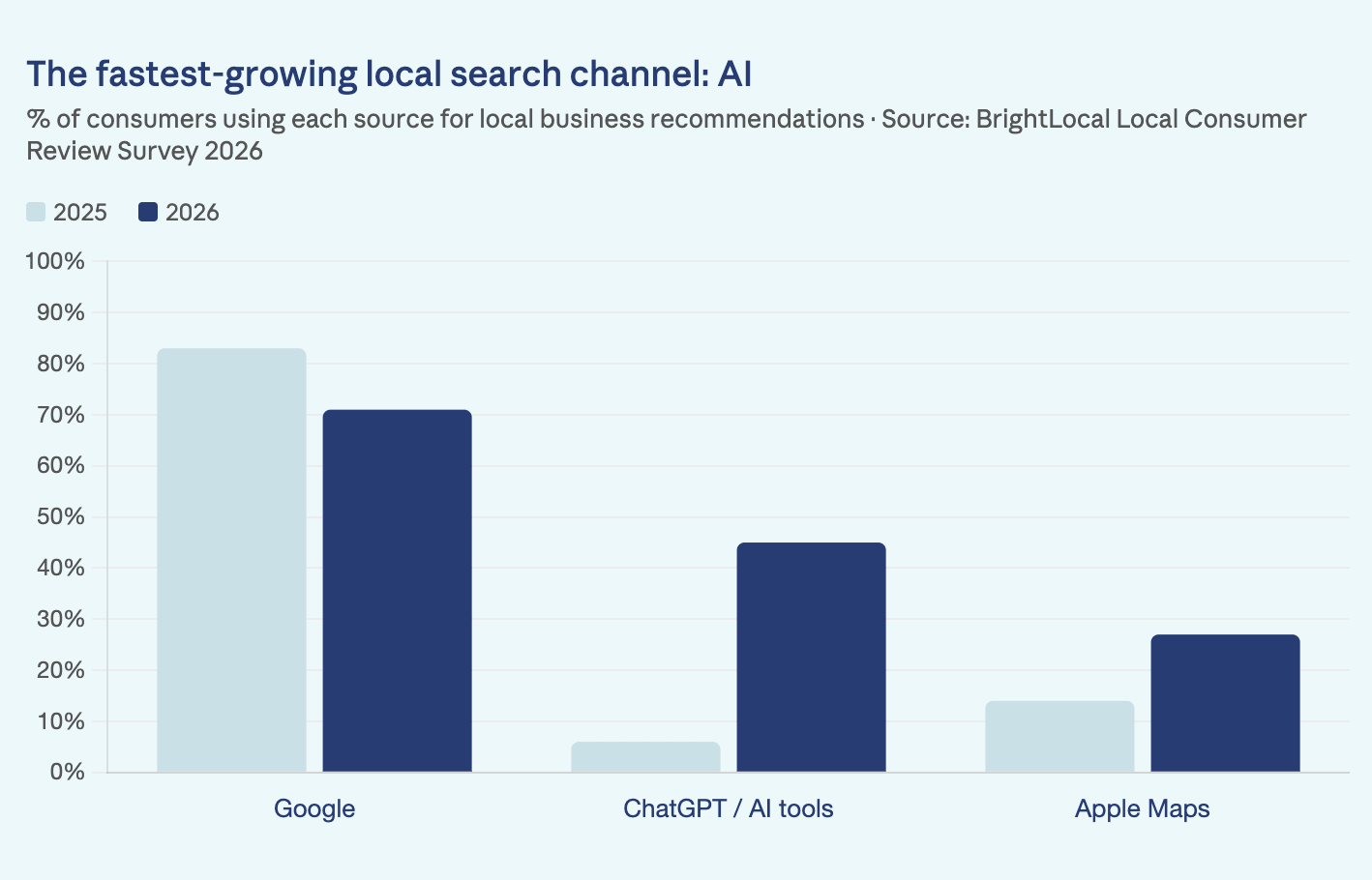
38. Use of ChatGPT and other generative AI tools for local business recommendations exploded from 6% to 45% in a single year, becoming the third most popular source of business recommendations behind Google and Facebook, outpacing Yelp and TripAdvisor. If your business isn't being surfaced by AI, you're invisible to a fast-growing slice of buyers. (BrightLocal Local Consumer Review Survey)
39. Google's share of local reviews dropped from 83% in 2025 to 71% in 2026, as Apple Maps usage nearly doubled (14% → 27%) and YouTube, Instagram, and TikTok gained share for video-based reviews. Diversifying beyond Google is no longer optional. (BrightLocal Local Consumer Review Survey)
40. Consumers now use an average of six review sites in 2026 before choosing a local business. (BrightLocal Local Consumer Review Survey)
Lead Conversion and Phone Calls
41. 37% of phone leads to home service businesses convert during the call, and 61% of callers speak directly with a person when a person actually answers. Call answer rates vary from 54% to 69% across industries, meaning roughly a third of revenue opportunities die at the answer step. (Invoca Call Conversion Industry Benchmarks Report)
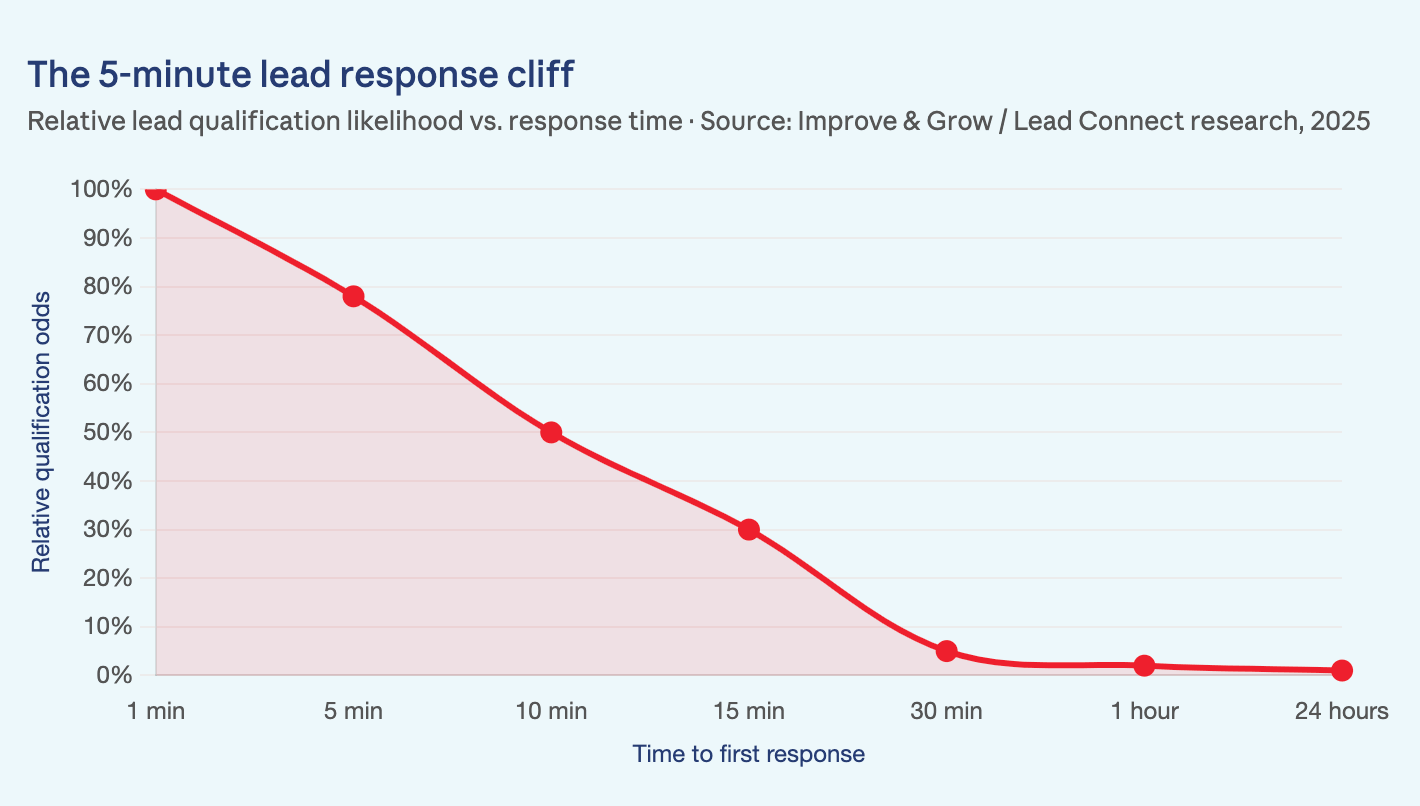
42. Contacting a lead within 5 minutes makes you 21x more likely to qualify them than waiting 30 minutes. Research has documented up to a 391% increase in conversions when leads are contacted within 1 minute of inquiry. The lead response window is now measured in minutes, not hours. (Improve & Grow / Vendasta)
43. 78% of customers buy from the company that responds to their inquiry first, regardless of price. In home services, where homeowners typically contact 3–5 providers simultaneously, "first to respond" has become the most important lead-quality variable in the funnel. (Vendasta / Lead Connect)
Customer Communication Preferences
44. SMS open rates are around 98%, with most messages read within minutes. Among generations, 75% of millennials consider phone calls "too time-consuming," and Baby Boomers are now twice as likely to text than call. (Signpost / SimpleTexting SMS Marketing Report)
45. 53% of homeowners are now comfortable with AI handling their initial service inquiry, with millennials reporting even higher comfort levels. The trust ceiling for automated first-touch is higher than most contractors assume. (Housecall Pro Home Service Customer Service Report)
46. Online booking, digital payments, and professional websites now meaningfully influence hiring decisions, with homeowners prioritizing speed, communication, and reputation alongside digital convenience. Websites that look 2018 are losing 2026 leads. (Housecall Pro Home Service Customer Service Report, link above)
Customer Preferences and Expectations: Gen X vs. Millennials
The most important demographic shift in home services right now is generational. Millennials have officially become the dominant spenders, while Gen X holds the largest renovation budgets per project, and Boomers still own most of the homes. Understanding the difference is now a marketing and pricing imperative.
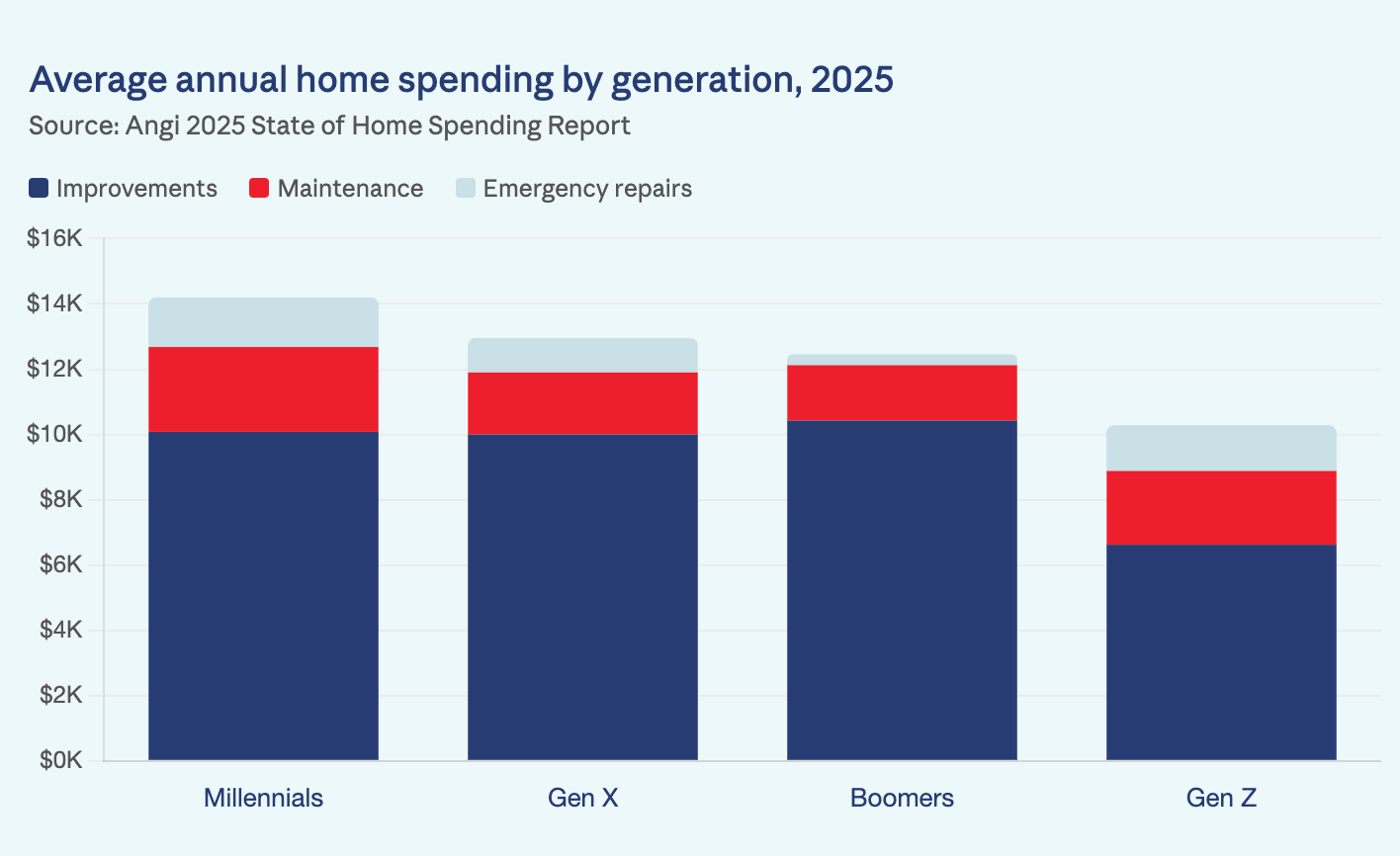
47. Millennials led all generations in total home spending at $14,199 per household in 2025. They even outspent Gen X ($12,956), Boomers ($12,454), and Gen Z ($10,283). Millennials also lead in maintenance spend ($2,601) and emergency repair spend ($1,519). (Angi State of Home Spending Report)
48. 77% of surveyed Millennials plan to take on a major home project in the next five years. This is the highest of any generation. With elevated mortgage rates keeping them in their existing homes, the "renovate rather than relocate" pattern is now structural. (Angi State of Home Spending Report)
49. Millennials made up 38% of all U.S. homebuyers, more than any other generation, while Gen X contributed another 24%. Boomers still own 80% of homes among their cohort, but the buyer pipeline is decisively younger. (National Association of Realtors via HIRI)
50. 60% of millennials and 56% of Gen Z homeowners have renovation plans for 2025, compared to just 32% of Baby Boomers. Younger generations are also more likely to renovate for personal style and customization, while Boomers focus on maintenance and necessary repairs. (This Old House survey via Fortune)
51. Median kitchen remodel spend hit $24,000 in 2025 (up from $22,000), while primary bathroom median spend rose to $15,000 (up from $13,000). Kitchens and bathrooms remain the highest-investment categories across every generation. (Houzz House & Home Study)
52. Millennials are 3x more likely than Boomers to rehire a business based on ease and convenience. Among all generations, 70%+ of homeowners would pay more for a Pro with a better service reputation. (Housecall Pro Home Service Customer Service Report)
53. 50% of all homeowners plan to renovate in 2026, with 37% of 2025 renovators having exceeded their planned project budget. Higher-than-expected costs and material upgrades were the top reasons for budget overruns. (Houzz House & Home Study)
Revenue and Financial Trends
The contractors making the most money right now aren't the cheapest, and they aren't necessarily the busiest. They're the ones who've moved into electrification, recurring-revenue maintenance plans, and pricing transparency.
54. U.S. homeowners spent an average of $12,472 on home projects in 2025, a 3.5% increase from 2024. Households also completed more projects on average: 10 in 2025, up from 9 the year before. (Angi State of Home Spending Report)
55. Heat pump retrofits command 20–30% price premiums over traditional HVAC replacements, and systematic growth strategies in electrification (heat pumps, EV chargers, electric water heaters) typically deliver 20–35% revenue growth. Contractors that haven't built capability in these areas are watching customers migrate. (Lightning Path Partners HVAC Industry Trends)
56. The global HVAC market exceeded $350 billion in 2025, with mid-single-digit CAGR projected through the next decade. Recurring revenue from maintenance plans and multi-trade bundles (HVAC + plumbing + electrical) is what's drawing private-equity capital into the space. (Kroll M&A Residential HVAC Services Industry Report)
57. Material costs for roofing rose 6–10% in 2025, continuing the steady climb seen since 2020. The price index for Asphalt Paving and Roofing Materials Manufacturing reached an all-time high of 391.6 in January 2025. Contractors who haven't updated pricing are absorbing margin compression. (Fixr.com U.S. Roofing Industry Statistics)
58. 53% of contractors are now prioritizing existing customers over new acquisition (31%) for their 2026 growth strategy. The math is finally being acknowledged industry-wide: retention is meaningfully cheaper than acquisition. (Housing Wire)
Customer Satisfaction and Retention Rates
Customer expectations in 2026 don't look like customer expectations in 2020. Speed, transparency, and digital convenience are now the norm, not differentiators.
59. 97% of homeowners expect a contractor to provide transparent pricing before they decide to hire, and 72% would pay up to 10% more for a Pro with a better customer service reputation. Hidden fees and squishy estimates are the fastest way to lose a job in 2026. (Housecall Pro Home Service Customer Service Report)
60. 73% of homeowners would refer a Pro after an excellent experience. The CAC math has flipped: investing in delight pays back faster than investing in ads. (Housecall Pro Home Service Customer Service Report, link above)
61. 41% of consumers expect to be contacted within 5 minutes after reporting an issue, and 61% expect their problem to be resolved on the first interaction or they'll start considering competitors. (InMoment Conversational Intelligence Report)
62. 81% of consumers still require an interaction to resolve issues, even with the proliferation of self-service options. The phone (or its digital equivalent SMS, chat, video) is still where loyalty is won and lost. (InMoment Conversational Intelligence Report)
63. 50% of homeowners now expect flexible payment plans or financing options. Combined with the rise of online booking and AI-handled inquiries, financial flexibility has become a customer experience requirement, not a perk. (Housecall Pro Home Service Customer Service Report, link above)
How ServiceEmpireAI Can Help You
The data above isn’t just interesting trivia. It can literally be a roadmap. The contractors winning in 2026 are the ones who turn statistics like these into company initiatives, new systems, and routes that turn into revenue. AI that answers calls in seconds, marketing that captures every lead, customer experiences that get more referrals on autopilot.
That's exactly what ServiceEmpireAI is built for: service business owners who want to use AI to grow their empire.
Stop Wasting Time on Plans That Never Get Executed