Want to improve customer satisfaction in field services? Start with CSAT benchmarks.
CSAT (Customer Satisfaction Score) helps measure how happy customers are after specific interactions, like a repair or technician visit. The formula is simple:
Satisfied Responses divided by Total Responses, multiplied by 100.
Scores above 80% are strong; below 70% signals issues.
Here are the key takeaways for field service industries, then we'll dive into the specifics::
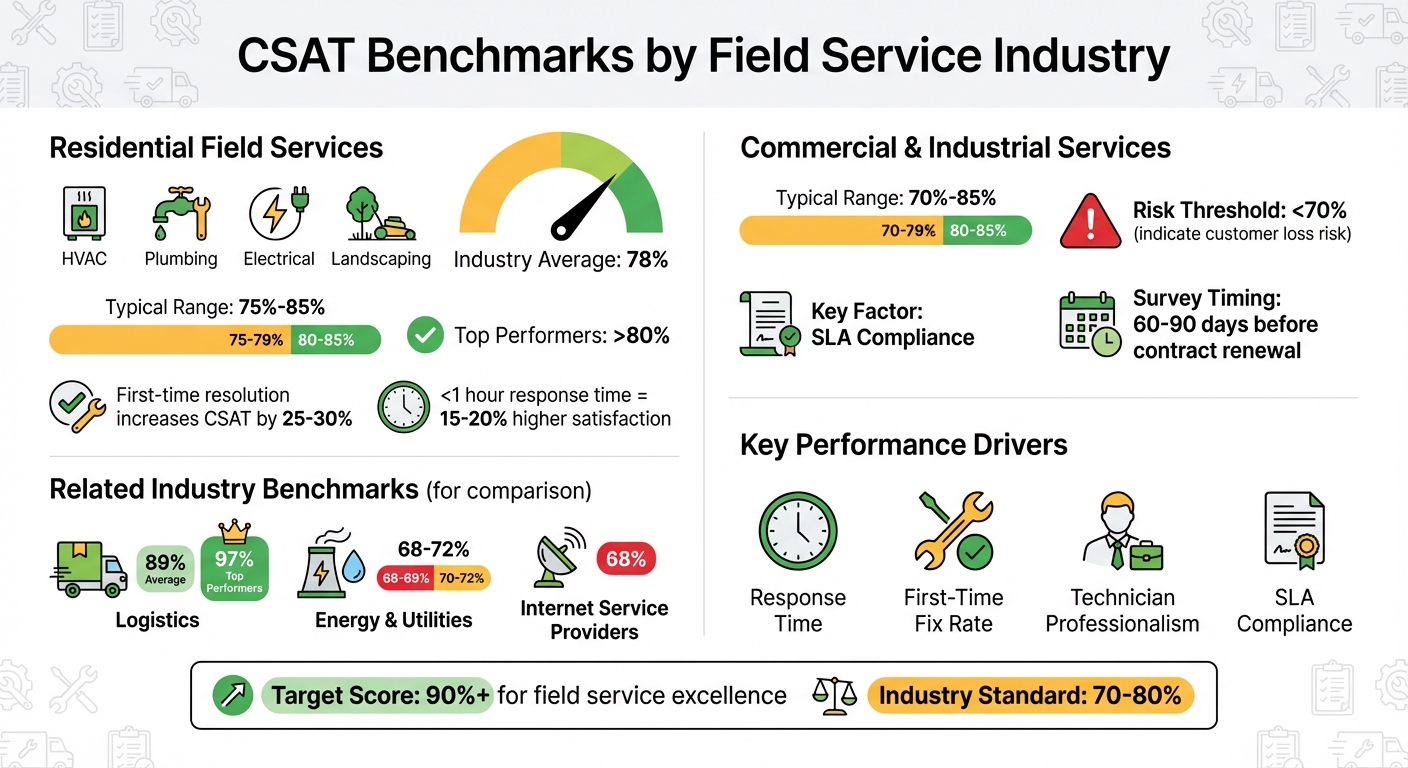
- Residential Services: Average CSAT is 78%; top performers exceed 80%.
- Commercial Services: Scores range from 70%-85%, with SLA compliance being critical.
- Improvement Factors: Response time, first-time fix rates, and technician professionalism drive satisfaction.
Use CSAT benchmarks and related KPIs (like repeat visit rates and service times) to identify weak points and improve customer loyalty. Our tools here at ServiceEmpire.AI can help translate insights into actionable steps.
Bottom line: High CSAT scores boost loyalty and revenue. Track, compare, and act to stay ahead.
CSAT Benchmarks by Industry Segment
CSAT Benchmarks by Field Service Industry: Performance Standards and Key Metrics
Residential Field Services
For residential field service companies (think HVAC, plumbing, electrical, and landscaping) CSAT scores typically range between 75% and 85%, with the industry average landing at 78%. Top-performing companies in this segment often exceed 80%. These figures align with the performance of leading home improvement retailers, where customer expectations for service quality and responsiveness are quite similar.
Getting it right the first time makes a big difference. Resolving an issue on the first interaction can increase CSAT by 25–30%. Quick response times also matter as a response within one hour correlates with 15–20% higher satisfaction scores. These are the kinds of operational goals that can turn satisfied customers into loyal ones.
Commercial and Industrial Field Services
In the commercial and B2B space, customer satisfaction depends heavily on meeting SLAs, ensuring equipment uptime, and demonstrating technical expertise. Here, CSAT scores generally range from 70% to 85%, while anything below 70% may indicate a risk of losing customers. CSAT doesn't just measure satisfaction; it can also highlight pain points in complex processes like onboarding, account upgrades, or managing multi-site services.
To address potential issues before they escalate, many commercial field service companies send CSAT surveys 60–90 days before contract renewals. This timing provides a chance to address concerns and improve retention. If industry-specific benchmarks aren't available, looking at related sectors can still provide valuable guidance.
Using Related Industry Data When Direct Benchmarks Aren't Available
If you can't find CSAT benchmarks specific to your field service niche, related industries with similar workflows can serve as a useful reference point. For instance:
- Logistics companies, which also focus on dispatch, routing, and customer communication, average a CSAT of 89%, with top performers hitting 97%.
- Energy and utilities providers, handling emergency calls and scheduled maintenance, typically score between 68% and 72%.
- Other Industry Average CSAT Ratings, courtesy of IBM
- Consumer shipping: 77
- Banks: 80
- Food manufacturing: 82
- Automobiles: 80
- Full-service restaurants: 84
- Social media: 74
- Airlines: 77
These proxy benchmarks can help you evaluate your own operations. By comparing your processes to those in similar industries, you can identify key drivers of customer satisfaction and see whether your approach aligns with what works in comparable business models.
What Drives High CSAT Scores
Main Factors That Affect CSAT in Field Services
Full Response Time (which includes acknowledgment, dispatch, and resolution) is a critical factor in achieving high CSAT. In my 30+ years of experience, response time has had a direct impact on a customer's overall satisfaction.
Another key metric is the First-Time Fix Rate, which evaluates whether technicians resolve issues during their initial visit. When technicians arrive unprepared, it not only frustrates customers but also leads to repeat visits and additional costs.
Technician professionalism also plays a significant role. Clear communication and expert advice leave lasting impressions on customers. Additionally, simplifying the process from scheduling to payment improves the Customer Effort Score (CES), which directly influences satisfaction levels. This factor is critical for both residential and commercial services.
Satisfaction Drivers by Service Type
Different types of clients value different aspects of service. Residential customers tend to focus on quick response times and interactions with polite, skilled technicians. On the other hand, commercial clients prioritize strict adherence to service level agreements (SLAs) and minimal operational disruptions. Preventative maintenance contracts often serve as a trust-building tool for long-term relationships.
If you're just getting started in this space and need some templates for those SLAs, go ahead and check out our service agreement template.
KPIs That Connect to CSAT Performance
Several key performance indicators (KPIs) provide actionable insights into CSAT performance and help identify areas for improvement:
- First-Time Fix Rate: This is a strong indicator of technician expertise and parts availability.
- Repeat Visit Rate: Tracking the frequency of follow-up visits within 7–30 days can reveal gaps in training or product quality issues that need addressing.
- Scheduling Accuracy and Mean Time to Service: These metrics reflect the efficiency of dispatch operations. Delays in these areas can quickly erode customer trust.
- AI Tools for Efficiency: Organizations using AI tools report faster resolution times. They also reduce unnecessary truck rolls, with better triage or remote support.
KPI: First-Time Fix Rate
Impact on CSAT: High
Dependent on: Technician skill and parts availability
KPI: Mean Time to Service
Impact on CSAT: High
Dependent on: Scheduling and dispatch efficiency
KPI: Customer Effort Score
Impact on CSAT: High
Dependent on: Friction points in the service journey
KPI: SLA Compliance Rate
Impact on CSAT: Medium/High
Dependent on: Whole team's ability to meet contractual commitments
KPI: Repeat Visit Rate
Impact on CSAT: Medium
Dependent on: Product defects and malfunctions, or inadequate testing
How to Use CSAT Benchmarks in Your Business
Setting Achievable CSAT Goals
Think of CSAT as a report card for individual service interactions. It’s a straightforward yet powerful metric for field service businesses to monitor and improve.
To get started, calculate your baseline using this formula:
(Total number of positive answers / Total number of responses) x 100.
Once you know your baseline, compare it to the industry standard of 70–80%. If your score falls below this range, focus on closing the gap before setting more ambitious goals.
For field service leaders, aiming for a CSAT of 90% or higher is ideal. Why? Because research shows that higher satisfaction levels can boost revenue by up to 15% while cutting service costs.
To make these goals actionable, tie them to key operational metrics like First-Time Fix Rate and Response Time. These are critical levers in field services. In fact, if all team members performed at the level of the top 20%, think how great your organization would be doing. Aligning CSAT improvements with these KPIs ensures that better customer satisfaction leads to tangible operational benefits.
Building a CSAT Measurement System
Once you’ve set clear goals, the next step is building a system to consistently gather and act on customer feedback.
A solid measurement system combines direct feedback (like surveys and NPS) with operational KPIs such as First-Time Fix Rate and SLA Compliance. Surveys alone can leave gaps, especially if response rates are low, so integrating both approaches gives you a fuller picture.
Timing matters. Send CSAT surveys immediately after a service event. For contract-based services, it’s smart to survey six months before renewal. This gives your sales team enough time to address any issues and prevent churn.
Keep surveys short and focused, ideally with 6–7 questions. Use a mix of Likert scales (1–5 or 1–10) and open-ended questions. Avoid combining multiple ideas into one question, like “Was our technician friendly and fast?” - this can muddy the responses. Always include an "N/A" option so customers can skip irrelevant questions without abandoning the survey.
One of the most valuable questions to ask is:
"What can we do better to improve our rating next time?"
This turns low scores into actionable insights.
Beyond surveys, track operational metrics that act as early warning signs. For example, monitor your Repeat Visit Rate (follow-ups within 7–30 days) to identify training gaps or product issues. Keep an eye on Mean Time to Service and SLA Compliance Rate to ensure efficient dispatching and meet contractual obligations.
Measuring field service KPIs to improve your organization's service performance is the first step on your path to growth. Keep doing it for years and decades to come, and you'll outperform your competition.
If you’re ready to take it a step further, sentiment analysis can provide deeper insights. By analyzing customer language in calls, emails, and social media, sentiment analysis can enhance the accuracy of CSAT metrics from 7% to 16%. Interestingly, less than 1 in 5 field service organizations currently use sentiment analysis, making it a valuable opportunity for early adopters.
Tools to Turn CSAT Data Into Action
After measuring your performance, the next challenge is turning that data into meaningful improvements. That’s where targeted tools come in.
Here at ServiceEmpire.AI, we offer free tools tailored for field service owners to convert CSAT insights into operational changes. For example, our custom SOP generators help standardize behaviors that drive satisfaction, like first-time fix protocols, customer communication scripts, and follow-up processes. If slow response times are dragging down your CSAT, a dispatch confirmation SOP can ensure customers receive prompt updates with accurate arrival windows.
The platform also includes service recovery scripts and NPS tracking frameworks to help you address dissatisfied customers before they leave negative reviews or switch to competitors. This is crucial because, according to PricewaterhouseCoopers (PwC), 52% of customers will stop doing business with a brand they love after just one bad experience.
By linking CSAT trends with operational metrics like First-Time Fix Rate and Mean Time to Service, you can identify the root causes of any dips in satisfaction. For instance, if a specific service area shows a decline, cross-referencing it with technician performance data or Repeat Visit Rates can reveal the issue.
ServiceEmpire.AI also indirectly tackles the importance of technician professionalism. Our hiring and retention frameworks help you build high-performing teams. Top organizations using AI tools for service professionals report 39% faster resolution times, and the systems we give you are designed to help you achieve similar results.
The best part? All these tools are 100% free with no credit card required. Built by operators who’ve scaled from single trucks to nine-figure service businesses, the tools are designed to give field service owners like you the resources you need to turn CSAT data into growth.
Reading CSAT Trends for Long-Term Growth
Tracking CSAT Changes Over Time
CSAT isn’t a static number. It shifts as your business evolves. To uncover meaningful patterns, it’s essential to measure CSAT regularly, whether monthly, quarterly, or at pivotal moments like customer onboarding, after service events, or before contract renewals.
Timing matters. Surveys sent within 24–48 hours of a service event are more likely to capture accurate, fresh feedback. This quick turnaround helps you spot early shifts in customer sentiment. It also highlights what’s called the "perception gap." This is the difference between what businesses assume and what customers actually experience. Tracking these changes over time ensures your internal assumptions align with customer reality.
Certain early warning signs, like declining Response Time scores, can hint at future customer dissatisfaction. Similarly, a drop in your First-Time Fix Rate might point to issues like insufficient technician training or a mismatch between their skills and the job requirements.
Once you’ve established overall trends, dig deeper. Break down CSAT data by technician, job type, or region to uncover actionable ways to improve.
Breaking Down CSAT Data for Better Insights
Overall CSAT trends are useful, but they only tell part of the story. To truly understand what’s driving customer satisfaction - or dissatisfaction - you need to segment your data. Breaking down scores by technician, job type, and region can shed light on specific problem areas.
For instance, if one technician consistently scores below the team average, it’s a clear indicator that additional coaching or support may be needed. If satisfaction scores for emergency repairs are lower than for routine services, it might be time to revisit your response protocols or set clearer expectations with customers.
You can also analyze your Repeat Visit Rate by product line. A high rate of repeat visits could signal product defects or gaps in on-site testing. If a particular region sees more frequent re-service requests within 7–30 days, it’s a cue to look at product quality or refine processes in that area. These insights make it easier to implement targeted improvements that address the root causes of dissatisfaction.
Leading field service companies are going beyond basic surveys. Many now use sentiment analysis to gain deeper insights into customer feedback. By analyzing emails, calls, and social media, sentiment analysis can increase the accuracy of CSAT metrics, boosting the percentage of organizations reporting their metrics as "extremely accurate" from 7% to 16%.
How CSAT Affects Customer Retention and Revenue
CSAT has a direct impact on customer retention and revenue. High CSAT scores often predict stronger customer loyalty, which translates into steadier revenue streams.
One key financial metric tied to CSAT is the Attach Rate: the percentage of customers with additional purchases added to their original purchase (for example, preventative maintenance contracts). A rising Attach Rate signals long-term customer commitment and provides a reliable income source. In commercial field services, this metric reflects both customer satisfaction and financial health.
The connection between CSAT and operational efficiency is equally important. For example, top-performing field service companies using AI tools report 39% faster Resolution Times. If every team member operated at the level of the top 20%, organizations could shave thousands upon thousands off service costs. These operational gains not only improve margins but also enhance the overall customer experience.
There’s also room to cut waste. About 14% of truck rolls are unnecessary, representing a clear opportunity to reduce costs. By tracking CSAT along with operational metrics like First-Time Fix Rate, you can identify inefficiencies, address them, and improve both customer satisfaction and cost management.
Finally, don’t overlook the Customer Effort Score (CES). High effort during a service event can drive customers away. Monitoring CES alongside CSAT helps pinpoint friction points in the service journey, giving you a chance to resolve them before they lead to churn. This dual approach ensures you’re not just meeting customer expectations but exceeding them.
Conclusion: Using CSAT to Drive Field Service Success
Customer Satisfaction (CSAT) is more than just a number. It’s a true key performance indicator, a predictor of customer loyalty and revenue growth. Whether you’re running an HVAC company, a plumbing business, or an electrical service operation, understanding how your CSAT score stacks up against industry benchmarks can provide a clear path for improvement. This insight lays the groundwork for better operations and smarter tracking, which are essential for long-term success.
The numbers tell a powerful story. Metrics like CSAT reveal opportunities for cutting costs, speeding up resolution times, and minimizing waste. But the data also highlights a critical challenge: there’s often a gap between how companies perceive their improvements and how customers actually feel. For example, while 50% of customer experience professionals report seeing progress, only 18% of consumers agree. This disconnect underscores the importance of ongoing measurement and analysis.
Pairing CSAT with operational metrics like First-Time Fix Rate and Response Time offers a clearer picture of where to make meaningful changes. These combined insights can pinpoint exactly where your service needs fine-tuning, ensuring you’re addressing the issues that matter most to your customers.
The companies that thrive in this space are the ones that actively listen to their customers, track the right metrics, and adapt their strategies based on data. Start by establishing your baseline CSAT score, compare it against industry benchmarks, and focus on targeted actions to improve. Consistent tracking and refinement will keep you ahead of the competition.
Your CSAT score is a reflection of your service quality, team performance, and potential for future growth. By monitoring it regularly and using digital tools like ServiceEmpire.AI, you can turn customer feedback into actionable strategies. This approach not only helps you improve but also builds trust and earns customer referrals. Both are key ingredients for lasting success.
FAQs
What factors impact Customer Satisfaction (CSAT) scores in field service industries?
Several factors significantly influence CSAT scores in field service industries. One of the biggest contributors? Fixing the issue on the first visit. Customers are noticeably happier when their problem is resolved without the need for follow-up appointments. Timeliness is another major factor, showing up on time and resolving issues quickly shows respect for the customer’s schedule and builds trust.
The professionalism and skill of technicians also play a vital role. Customers appreciate clear communication, courteous behavior, and expertise that gets the job done right. On top of that, transparent pricing and a hassle-free scheduling process go a long way in fostering trust and avoiding any unpleasant surprises.
How businesses gather feedback can also influence CSAT scores. Short, well-timed surveys tend to perform better than long or overly frequent ones, which can lead to “survey fatigue” and fewer responses. Companies that focus on a customer-first approach and use tools like AI-powered scheduling or mobile work orders often see better results. These tools streamline operations, making the entire experience smoother and more enjoyable for the customer.
How can field service businesses use CSAT benchmarks to boost customer loyalty?
The Customer Satisfaction Score (CSAT) is a simple yet powerful way to gauge how happy customers are with a service. It usually relies on an easy-to-understand scale, like 1–5 or 1–10. For field service businesses, this metric is especially important because it captures how customers feel about a technician's visit. And here’s the kicker: higher CSAT scores often mean more repeat customers and referrals.
To make the most of CSAT benchmarks, start by gathering post-job surveys. Then, compare your average scores to the industry standards. This comparison can reveal areas where you might be falling short, whether it’s speeding up resolution times or simplifying your processes. Tools like ServiceEmpire.AI can help you tackle these challenges. With it, you can design trade-specific standard operating procedures (SOPs), train your teams on best practices, and set clear, actionable goals for improvement.
But don’t stop there. Keep an eye on your updated CSAT scores regularly. This will help you see if your efforts are paying off, ensuring customer loyalty while giving your business the boost it needs to thrive.
How can field service businesses use CSAT data to improve customer satisfaction?
Customer Satisfaction (CSAT) scores provide a quick glimpse into how your clients feel about your service, but their real power lies in how you use that information. By digging into feedback trends, spotting recurring issues, and addressing low-rated visits right away, businesses can make real improvements. AI tools can play a big role here, helping to highlight common customer frustrations, flag potential problem areas, and even predict issues before they arise.
For field service businesses, there's an opportunity to go even further. Comparing your CSAT scores with industry benchmarks can help pinpoint areas for growth and set clear goals. Platforms like ServiceEmpire.AI make this process easier by offering trade-specific Standard Operating Procedures (SOPs), crafting hiring prompts to attract skilled professionals, and providing leadership frameworks to keep teams accountable. Regularly reviewing AI-driven insights, coaching staff, and fine-tuning processes based on feedback ensures steady progress. The result? Happier customers, quicker problem-solving, and stronger loyalty.
Lead With Confidence and Clear Direction