In field service, every team member's safety is paramount. Whether your technicians are climbing into attics, dealing with electrical systems, or handling hazardous materials, a robust safety training program ensures compliance. It's about sending everyone home safely every day. The approach I outline below has helped companies reduce workplace incidents in a variety of different service businesses.
Let me start with the most common questions I hear around construction safety training, then I'll dive into more specifics about how to assess risk and build a safety program from scratch. (Construction safety fail pictures included)
Do You Need OSHA Training and Certification in Construction?
Yes and No. As a construction company, you need at least 1 person in your organization fully trained and certified by OSHA. It is voluntary, but I would argue it is necessary if you want to stay in business. If you're a small business, it will likely be your responsibility as the owner to become OSHA certified. If you're a larger business with 25, 50, 100+ employees, it will likely be your responsibility as the owner, plus a couple core leaders. Maybe you take your production manager, your safety manager, and/or crew leaders that you want to build around.
In many construction companies, the owner and safety manager take the 30-hour OSHA course, while crew leaders and production manager take the 10-hour OSHA course. Please note: there is a difference between the Construction vs. General Industry versions of OSHA trainings as well.
You can find out more details about the OSHA training costs, locations, and expectations here.

Does Your Entire Team Need OSHA Training and Certification?
Likely not. As a construction company, you want at least 1 person in your organization fully OSHA trained as mentioned above. But it is not a requirement to have your entire team attend OSHA training.
You should, however, make sure every person in your company has safety training at the appropriate level for their job. As an employer, it is your job to provide a safe working environment for your team. The training should be documented and trackable. It should cover the core components, and as someone is promoted, the level of safety training should increase alongside the promotion.
What Other Safety Trainings and Certifications Are Available?
There are hundreds, if not thousands, of options for additional safety trainings and certifications aside from the OSHA 30-hr and OSHA 10-hr Construction courses. Some are in-person still, if that is preferable for your team. Some are virtual, if that is the better option for your team. Some programs offer both in-person or virtual. Here are a few notable safety programs:
- National Safety Council (NSC)
- HSI
- Click Safety
- Alliance Safety Council
- National Association of Safety Professionals (NASP)
- American Society of Safety Professionals (ASSP)
- WorkHub
- Alchemy Systems
- SC Training (formerly EdApp)
- Local Community Colleges
Now, let's dive into risk assessment, common safety practices, documentation, improvement, and building a safety program from scratch.
Risk Prevention: Stop Problems Before They Start
The best safety incidents are the ones that never happen. Start with these foundational elements:
Risk Profiles: Create detailed risk profiles for every type of job your team handles. For HVAC technicians, this means documenting hazards from electrical work to confined spaces. For plumbers, it covers everything from chemical exposure to lifting injuries. For carpenters, drywallers, and roofers, it may be ladders, scaffolding, and fall protection.
Job Safety Analysis (JSA): Break down common tasks into step-by-step procedures, identifying potential hazards at each stage. For example, when installing a water heater, document risks from disconnecting power to proper lifting techniques.
Preventive Equipment Maintenance: Establish strict schedules for tool and equipment inspections. Faulty equipment causes preventable accidents. Create checklists for daily, weekly, and monthly equipment checks.
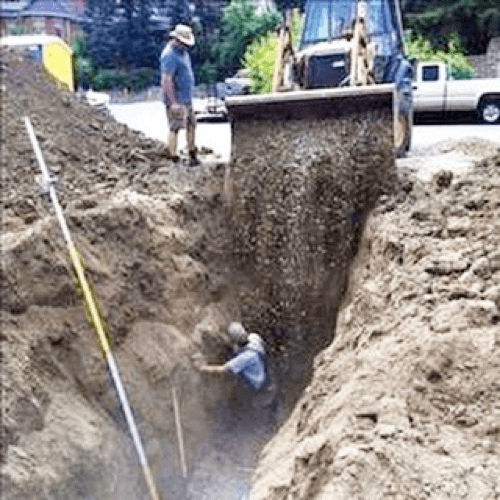
A risk profile and job-safety analysis could have gone a long way for this gentleman. A hard-hat may have helped too. I don't want you or anyone you know being buried.
Daily & Weekly Safety Practices: Making Safety Second Nature
Safety excellence comes from consistent habits, not occasional training sessions:
The "Take Five" Program
Before starting any job, technicians take five minutes to complete a simple pre-job safety checklist:
- Survey the work area
- Identify potential hazards
- Check personal protective equipment (PPE)
- Review relevant emergency and safety procedures
- Verify tool conditions
Morning Safety Huddles
Start one day per week with a 10-minute safety discussion:
- Review any recent close calls or incidents
- Share specific job site concerns
- Discuss weather-related hazards for that season
- Check PPE compliance
- Address team questions
Two-Way Communication
Encourage immediate reporting of:
- Near-miss incidents
- Equipment issues
- Unsafe conditions
- Customer site hazards
- Process improvement suggestions
New-Hire Safety Introductions
When you hire a new technician or new staff, have them go through a basic safety training, led by your onboarding specialist or safety manager. Start a new employee safety record and log this as their first completed training. If they will be operating a forklift or heavy equipment, be sure to get them trained on that as well.
Basic safety training should be a part of every new hire's onboarding experience. This communicates the importance of safety in your organization, and makes sure you don't have costly mistakes with your greenest temps or full-time employees.

These two guys were probably new hires, just started this morning!
Documentation: If It's Not Recorded, It Didn't Happen
Proper documentation protects your team and your business:
Digital Safety Forms
Create mobile-friendly forms for:
- Job site safety assessments
- Equipment inspections
- Incident reports
- Near-miss documentation
- Training completion records
Photo Documentation
Consider what photos you may want to require:
- Setup of safety equipment
- Hazardous conditions found
- Completed safety measures
- Incident scenes (when applicable)
- PPE or Hazmat compliance
Training Records
Detailed training records are an important part of HR, of a Quality Management System, and of a Safety Program:
- Initial safety training
- Ongoing certification updates
- Specialized equipment training
- Safety meeting attendance
- Individual competency assessments
Improvement Plans: Continuous Evolution of Safety
Every safety manager in the country will tell you,
"Safety training isn't a one-time event. It's an ongoing process."
New hazards enter the workplace. New employees enter the workplace. Or, it could be older employees who thought they had it all figured out and then they have a slip or fall on the company's dime. You'd be amazed how often it's the longer tenured employees who get hurt rather than the new ones who "have no clue what they're doing yet." That's why your whole team needs to be continually learning how to prevent workplace accidents:
Monthly Analysis
Review key metrics:
- Incident rates by type
- Near-miss reports
- Training completion rates
- Safety audit results
- Employee feedback
Quarterly Updates
Revise training materials based on industry regulation changes and new equipment requirements. When you have a proactive team, they may have input for how to improve your training materials with best practices. Of course, every new hire also has fresh eyes on your safety training materials. Ask them if they have any feedback that could help you revise safety SOPs.
Annual Certification
Create yearly certification requirements. This can include the core safety procedures, emergency response (like first aid and CPR), as well as heavy equipment operation. Many pieces of heavy equipment have their own safety certification schedules (like CDLs), but you can also have them for forklifts, cranes, and more. Of course, your industry might have ongoing education requirements that may or may not include safety training within them as well.
When safety is top of mind, your organization will run better.
Timeline for Action When Starting from Scratch
If you're trying to start a safety program from scratch, first, you should take an OSHA 30-hour or OSHA 10-hour training program yourself. Then, bring back those lessons to your workplace and start building what you learned. Here are some good guidelines:
Week 1-2:
- Conduct initial safety assessment
- Document current procedures
- Identify high-risk areas
- Create baseline metrics
Week 3-4:
- Implement daily safety practices
- Train supervisors on new protocols
- Set up documentation systems
- Begin morning huddles
Month 2:
- Roll out comprehensive training
- Start tracking key metrics
- Establish feedback loops
- Monitor compliance
Month 3:
- Review initial results
- Adjust procedures as needed
- Celebrate safety wins
- Address any gaps

That might be a gap to address.
The Results
When you follow the guidelines I've laid out above, you'll see an improvement in your safety metrics across the board.
- Reduction in workplace incidents
- Decrease in workers' compensation claims
- Improvement in safety compliance
- Reduction in lost work days
- Decrease in insurance premiums
Remember: Safety excellence is about creating a culture, not just following rules. When every team member understands that safety is a core value, real change happens.
Make it personal and connect it to real life. Share real stories about why safety matters. When a veteran technician explains how proper lockout/tagout procedures prevented a serious accident, it resonates more than reading from a manual.
Once you reach your company's safety goals, then it's all about maintaining them. Keep your program fresh, relevant, and engaging. Your team's well-being depends on it.