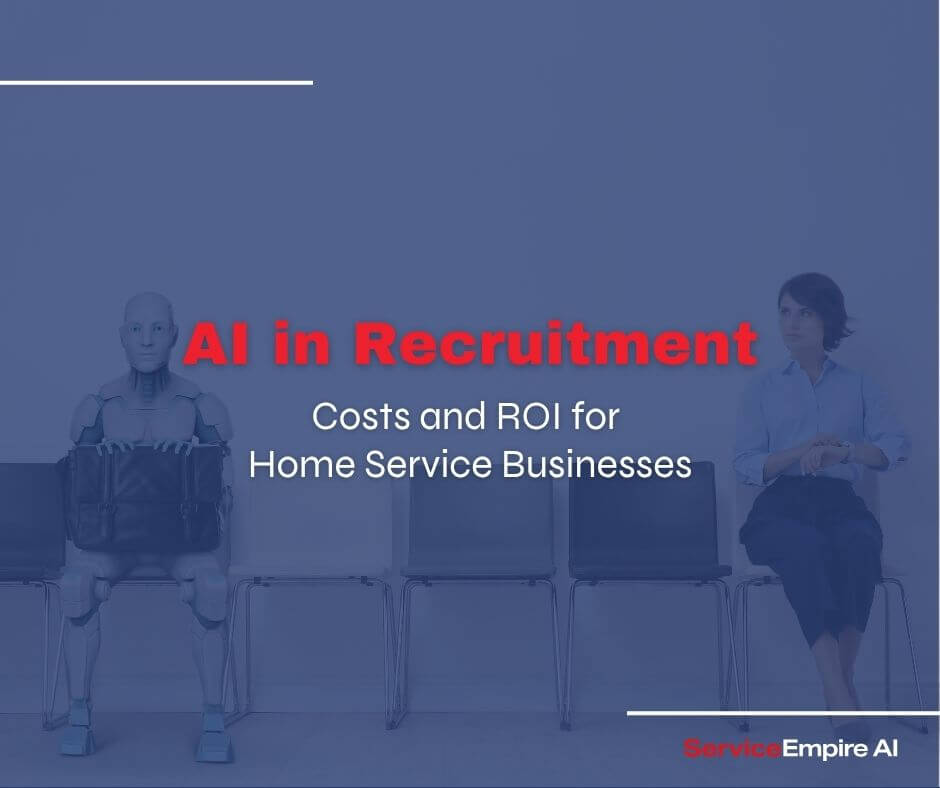
AI recruitment tools are saving U.S. service businesses time and money by addressing hiring challenges like technician shortages, seasonal spikes, and high turnover. Companies using AI report a 42% faster hiring process, reducing time-to-fill from 42 days to 24, and cutting costs-per-hire by 37%. With an average savings of $2,800 per hire and a 320% ROI in the first year, AI is reshaping how businesses recruit.
Key Takeaways:
- Cost of AI Implementation: Initial setup ranges from $25,000 to $100,000, with annual licensing fees of $6,000–$18,000 for small businesses.
- Savings with AI: Traditional hiring costs average $7,600 per hire, while AI reduces this to $4,800 - a 36.8% savings.
- Time Saved: Recruiter and manager hours drop by over 50% per hire, saving 860+ hours annually for businesses hiring 50 technicians.
- Faster Hiring: AI shortens hiring timelines by 18 days, allowing new employees to generate revenue sooner.
- Retention Benefits: AI improves candidate matching, reducing first-year attrition by 30%, saving small businesses $22,500 annually.
AI tools like ServiceEmpire.AI offer free recruitment solutions tailored to HVAC, plumbing, and field service industries, making AI adoption accessible for small businesses. By lowering costs, speeding up hiring, and providing strategies for boosting retention, these tools ensure businesses stay competitive and profitable.
What AI Recruitment Actually Costs
Before diving into the return on investment (ROI) of AI recruitment, it’s crucial to understand the associated costs. These expenses generally fall into three main categories: software expenses, training and integration, and ongoing maintenance. While the total investment can vary depending on your company’s size and hiring needs, here’s a closer look at what most service businesses can anticipate. This breakdown lays the groundwork for evaluating AI’s impact on ROI in later sections.
Software and Tool Expenses
Implementing AI recruitment technology involves an upfront cost of $25,000 to $100,000 for setup. After this initial investment, companies typically pay monthly licensing fees ranging from $500 to $1,500 per recruiter. For example, a small HVAC business with one hiring manager might spend between $6,000 and $18,000 annually. Larger businesses managing multiple locations and seasonal hires will see these costs scale up accordingly.
AI platforms also reduce job advertising costs, averaging $750 per position, a 40% savings compared to the traditional $1,250 spent on manual job board postings. Similarly, screening and assessment tools cost around $450 per hire with AI, compared to $800 using older methods.
Stats from HireGenix
Training and Integration Costs
The process of integrating AI tools involves expenses for system setup, staff training, and workflow adjustments, which typically range from $15,000 to $70,000.
Alex Lockey, Talent Strategist at The Satori Partnership, confirmed these additional costs, stating:
"In some cases, I've seen businesses where the total cost of AI implementation tripled once all expenses were included."
While these upfront costs can be hefty, companies often see a full ROI within 9 to 12 months, with the first 2 to 4 months dedicated to configuration and training. Additionally, ongoing support and maintenance usually account for 15% to 20% of the annual subscription cost.
Next, these costs are compared to traditional recruitment expenses to shed light on potential savings.
Traditional Hiring Costs for Comparison
Traditional hiring methods are far from inexpensive. Multiple sources confirm the average cost per hire using conventional approaches is $7,600, whereas AI-powered tools bring that down to $4,800, a savings of 36.8%.
For service businesses hiring 50 technicians annually, switching to AI recruitment could translate into $140,000 in direct cost savings.
Calculating ROI: How AI Improves Recruitment Results
Core Metrics for Recruitment ROI
To truly understand how AI enhances recruitment, it's essential to focus on key metrics that measure its impact. Four metrics stand out:
- cost-per-hire (total recruitment expenses divided by hires)
- time-to-fill (days from job posting to acceptance)
- quality-of-hire (evaluated through first-year retention and performance)
- interview efficiency (total recruiter and manager hours spent per hire)
One often overlooked factor is the opportunity cost of a vacancy.
For example, leaving an HVAC technician or electrician role unfilled doesn't just strain the team. It can lead to lost revenue, delayed service calls, overworked employees, additional departures, and unhappy customers. For technical or specialized roles, every day a position remains vacant can cost between $450 and $900 in lost productivity. These metrics highlight how AI not only streamlines recruitment but also delivers measurable savings in both time and money.
Time and Money Saved with AI
AI recruitment tools bring serious time savings and cost savings to the table. According to HireGenix, recruiter time drops from 28.5 hours to 11.2 hours per hire - a 60.7% reduction - while hiring manager time decreases from 15.3 to 8.7 hours, saving 43.1% of their time. For a service business hiring 50 technicians annually, this translates to over 860 hours saved each year. If you're hiring that many technicians annually, be sure to check out this service business hiring checklist.
Speed is another game-changer. By cutting 18 days from the hiring process, new hires can start generating revenue nearly three weeks sooner. Considering that new employees typically generate 1.5 to 3.0 times their salary in additional revenue, faster onboarding has a direct financial impact. For example, a plumbing company paying technicians an annual salary of $55,000 could see an additional $15,000 to $30,000 in revenue per hire simply by accelerating the process. Just don't rush it too much and mis-hire, of course.
When You'll Break Even and Long-Term Returns
Most service businesses recover their initial investment in AI recruitment tools within 3 to 7 months, according to Greenhouse. The first 2 to 4 months are usually spent on setup, training, and adapting workflows. After that, the savings and productivity gains start to add up. By the end of the first year, companies typically report an ROI ranging from 300% to 400%.
For small to medium businesses with 50 to 200 employees, the ROI is usually over 2.5x. Take the example of a fintech startup: faced with $144,000 in productivity losses due to unfilled roles before they implemented AI-powered matching. This implementation reduced their hiring time from 52 days to 23 days, allowing them to fill 12 positions in 3 months and save $76,000 in recruitment costs.
The benefits don’t stop at cost savings. AI improves candidate matching, enhancing the quality of hires and boosting retention rates. By reducing first-year attrition by 30%, companies with 1,000 employees could save approximately $450,000 in turnover-related costs. For a smaller company, like a 50-person HVAC business, that same improvement could result in $22,500 in annual savings. These long-term gains make AI a compelling choice for businesses looking to improve their recruitment strategies.
How Service Businesses Use AI for Hiring
Service businesses often grapple with unique hiring challenges, such as seasonal spikes in demand, technician shortages, and the high costs of unfilled positions. By automating tedious processes and improving candidate quality, AI helps these businesses respond quickly during critical periods.
Hiring Faster During Peak Seasons
When peak seasons hit, service businesses need technicians yesterday, not weeks from now. AI-powered recruitment platforms step in to handle the surge in applications without requiring additional staffing. A great example? In 2025, UK-based fulfillment provider THG Fulfil used Job&Talent's AI recruiter, "Clara", to process an overwhelming 48,000 applications during their busy season. The result? 2,000 hires, a hiring timeline slashed from 8 weeks to just 3 weeks, and a 50% drop in attrition.
AI tools take over tasks like resume screening, ranking candidates based on job requirements, and even sending interview invites, all without human involvement. For instance, Swedish supermarket chain ICA used Hubert's AI-driven screening to fill job openings five times faster during a hectic five-day hiring push. Mobile-first platforms also make it easy for candidates to apply instantly via SMS or QR codes, even from service vehicles. These examples highlight a growing trend that U.S. service businesses can adopt to achieve similar results.
"Peak season is the ultimate test of workforce agility, and the old playbook no longer works. Businesses need speed, scale, and reliability." - Giuseppe Mozzillo, CEO International at Job&Talent
While speed is critical, ensuring the right hires stick around is just as important.
Finding Better Candidates with AI Screening
Fast hiring only works if the new employees stay. AI screening tools dig deeper by analyzing resumes for specific technical skills and using predictive algorithms to identify candidates likely to stick around. These tools improve candidate quality and cut first-year attrition, allowing hiring managers to focus on the top 15% of applicants according to HireGenix. Some AI systems even conduct structured interviews to assess motivation and technical competencies early in the process.
The financial benefits are hard to ignore. By filtering out less suitable applicants before recruiters even step in, AI ensures hiring managers spend their time on candidates most likely to succeed and remain with the company.
Minimizing Business Impact from Open Roles
Faster hiring means fewer productivity losses and reduced overtime costs. AI shortens the time-to-hire as we've seen, dropping the average hiring timeline from 42 days to just 24. This speed means new hires can start contributing to revenue nearly three weeks earlier, directly offsetting the costs of open roles.
Beyond filling positions quickly, AI also streamlines your onboarding systems. This means new hires can hit full productivity in days rather than weeks. For service businesses, this efficiency keeps revenue-generating assets (like trucks and technicians) fully operational and out in the field where they belong.
Free Hiring and Onboarding Tools
ServiceEmpire.AI simplifies the hiring process with trade-focused tools that identify essential technical skills. The platform creates AI-generated job descriptions, interview questions, and candidate evaluation frameworks customized for your specific trade. Additionally, it provides automated Standard Operating Procedures (SOPs) and onboarding frameworks. These tools help new hires become productive faster, directly addressing the $450–$900 daily cost of unfilled roles.
Reducing Turnover with Leadership Tools
Hiring the right people is just the start. Keeping them is equally important. ServiceEmpire.AI offers leadership and culture-building prompts designed to boost employee retention. These tools help align new hires with your company’s values, establish recognition systems, and facilitate meaningful one-on-one meetings. With AI-driven candidate matching, businesses see a 40% increase in employee tenure and a 30% reduction in first-year attrition. Given that replacing a poor hire can cost 50–200% of their annual salary, these retention-focused tools safeguard the savings achieved through smarter hiring practices.
By combining effective hiring with retention strategies, ServiceEmpire.AI offers a comprehensive, free, AI recruitment solution. Unlike traditional platforms that come with hefty price tags, ServiceEmpire.AI provides over 100 AI prompts across 18 categories - including hiring, onboarding, leadership, and SOPs - at no cost. This allows small service businesses to adopt AI-driven recruitment strategies that deliver returns quickly.
Conclusion
AI has proven to be a game-changer in recruitment, cutting cost-per-hire and reducing time-to-hire. Even more, with predictive reasoning, there is evidence that it seems to enhance retention rates. Considering that every unfilled technician role can cost businesses $450–$900 per day, saving time in the hiring process directly translates to increased profitability. The challenge now lies in adopting these tools swiftly.
ServiceEmpire.AI equips businesses with everything they need for AI-driven hiring. From crafting tailored job descriptions to building effective screening frameworks and onboarding SOPs, the platform ensures new hires become productive quickly. It doesn’t stop there - leadership and culture-building prompts are included to help businesses retain their top talent, tackling both recruitment and retention challenges head-on. All for no cost, no credit card required.
If you want faster screening, quicker placements, and lower turnover rates, you'll need to start using AI in your recruitment processes.
Why wait? Start applying these tools today. Focus on one high-volume role (perhaps your most frequently filled position or the one with the highest turnover). Leverage ServiceEmpire.AI to automate the screening process and simplify onboarding. Track your hiring metrics, and you’ll see measurable improvements.
FAQs
What are the costs of using AI for recruitment, and what should service businesses expect to invest?
The cost of using AI for recruitment can vary widely, depending on the tools you choose and the size of your business. Initial costs are often quite low, as many providers offer free trials or waive setup fees to make it easy to get started. When it comes to ongoing expenses, subscription fees can range from about $19 per user per month for basic options to $10,000–$35,000 annually for more advanced, enterprise-level systems.
It’s also important to consider extra expenses like training, integration, and support, which can add to your overall investment. For service-based businesses, platforms like ServiceEmpire.AI offer free-of-charge solutions specifically designed for field service industries. These tools can help you keep costs in check while ensuring a strong return on investment by streamlining your recruitment process.
How does AI help improve employee retention and lower turnover costs?
AI plays a key role in boosting employee retention by streamlining onboarding, cutting down on tedious administrative tasks, and increasing overall job satisfaction. It excels at identifying and hiring candidates who are better suited for their roles, which naturally leads to a more stable and committed workforce.
Fewer employee departures mean lower recruitment and training expenses, not to mention less disruption from constant staff changes. Over time, these improvements contribute to a more engaged team and substantial cost savings for your business.
What are the key benefits of using ServiceEmpire.AI for small service businesses?
ServiceEmpire.AI brings a game-changing suite of AI tools for small service businesses, completely free. Designed by seasoned professionals who’ve scaled businesses from a single truck to nine-figure operations, this platform delivers over 100 tools to simplify and enhance daily operations. From creating ready-to-launch Google and Facebook ad campaigns to offering trade-specific standard operating procedures, hiring prompts to attract top talent, and leadership frameworks to drive accountability, ServiceEmpire.AI provides everything without asking for a credit card.
One standout feature is its AI-powered recruiting tools. These tools can cut hiring costs, speed up the entire process, and free up time for business owners to focus on growing revenue. Beyond these tools, ServiceEmpire.AI connects users with expert advice through resources like the Field Service Insights blog (which you're reading now), offering actionable tips on marketing, management, and scaling a business.
End the Cycle of Employee Turnover and Burnout