Avoca, a leader in AI for field service businesses, has reached a $1 billion valuation after securing $125 million in funding as of late April 2026. The company’s AI voice agents help businesses recover 15%–25% of annual revenue by ensuring no inbound calls are missed. Starting in 2023 with a focus on restaurants, Avoca pivoted to home services, growing from 10 customers to over 800 by 2026. The funding, led by Meritech Capital and General Catalyst, will fuel technology upgrades, market expansion, and deeper software integrations.
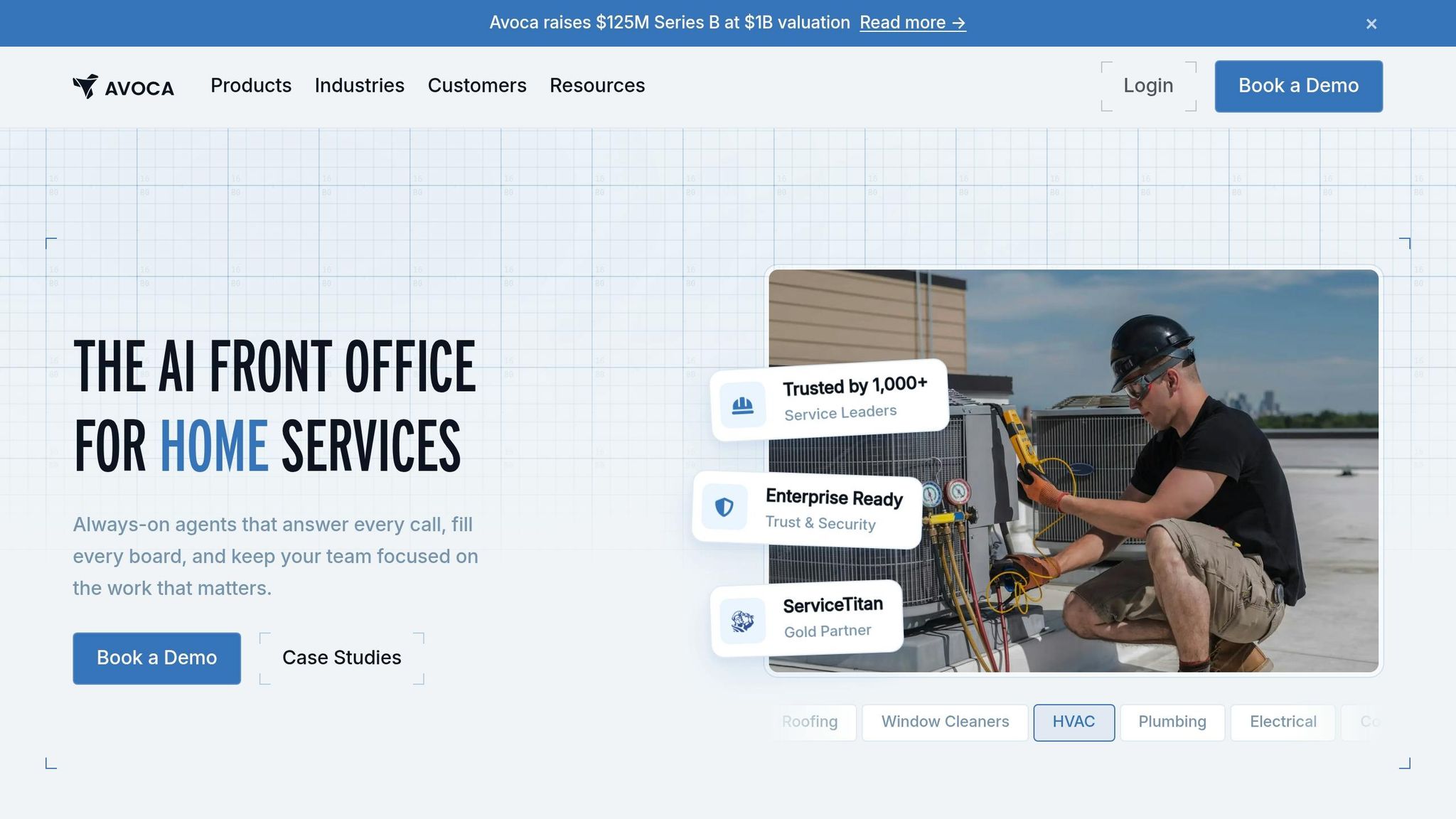
Avoca has set out to simplify the chaos that many field service businesses face with their fragmented systems for marketing, call centers, CRMs, dispatch, and payments. Typically, these businesses juggle multiple platforms, creating data silos, missed opportunities, and wasted marketing budgets. Avoca solves this by offering a single AI-native platform that handles the entire customer journey, from the first inquiry to the final payment.
The company operates on a SaaS subscription model. By 2025, Avoca had crossed eight figures in ARR, demonstrating how much demand there is for AI solutions that automate front-office operations. What makes Avoca stand out is its focus on providing businesses with AI agents that work tirelessly, without the constraints of human labor.
One of the platform's standout features is its ability to recover revenue rather than just cut costs. For instance, if a $15,000 HVAC estimate has been sitting idle for months, Avoca’s AI actively follows up to revive the opportunity. Co-founder Apurva Shrivastava described it best:
"Our AI is always on. It can answer a call and book a job directly at 3 a.m. It can autonomously revive that $15,000 unsold estimate from eight months ago sitting in your system."
This all-in-one approach lays the groundwork for the advanced AI tools that power every aspect of field service operations.
Avoca’s platform acts as a 24/7 AI-powered front office, managing inbound calls, web leads, chat, email, and SMS. It seamlessly integrates with industry CRMs like ServiceTitan, HousecallPro, and more ensuring no lead slips through the cracks during busy seasons or after hours. It also partners with Nexstar Network and connects with Clover for payments.
By automating routine tasks like follow-ups and appointment scheduling, Avoca not only saves time but also centralizes previously scattered data. This gives operators a clear view of which leads convert and which marketing strategies deliver the best ROI. These capabilities ensure that every missed call becomes an opportunity to generate revenue.
Avoca zeroed in on home services like HVAC, plumbing, and electrical companies, where a single missed call can mean losing out on tens of thousands of dollars. As co-founder Tyson Chen put it:
"When a home service business misses a phone call, that could be a $30,000, $40,000 HVAC install they're missing. So, instantly, we thought: 'wait, this is a completely different order of magnitude'."
Rescue Air, a heating and air company based in Dallas, became Avoca’s first customer in 2023. By April 2026, the platform had expanded to serve over 800 customers across the physical services sector. This includes both small businesses and large, multi-location operators. Bryan Enders, owner of H.L. Bowman in Pennsylvania, shared that Avoca had become their go-to AI solution for managing demand and staying in touch with customers.
While home services remain a core focus, Avoca is branching out into other high-value sectors, such as roofing, restoration, automotive services, moving, junk removal, and property management. Its ability to integrate deeply with existing systems means businesses can adopt it without overhauling their operations.
Avoca is building an AI workforce for the people who actually keep America running, aka thousands of service businesses across the country.
The potential market is massive. By 2025, the HVAC industry alone was valued at roughly $50 billion, while the broader U.S. services economy exceeds $1 trillion. With its AI-native platform, Avoca is positioned to help businesses in this under-digitized sector thrive, aiming to book $1 billion in jobs for its customers in 2026. This strategy not only maximizes revenue but also highlights the transformative role AI can play in scaling field service operations.
Avoca’s path to achieving a $1 billion valuation began with its 2024 seed round, spearheaded by Y Combinator. This funding allowed the company to move beyond its initial focus on Rescue Air and push for broader adoption of its services.
During the Series A round, Kleiner Perkins led the charge, with partner Leigh Marie Braswell championing the investment after meeting Avoca co-founders Tyson Chen and Apurva Shrivastava at MIT. Amplify Partners also joined this round, helping the company scale its AI workforce for home services.
By April 2026, the Series B round propelled Avoca into unicorn status. Co-led by Meritech Capital Partners and General Catalyst, the round also saw continued support from Kleiner Perkins, Amplify Partners, and Nexus Venture Partners. Armed with this $125M funding, Avoca is now focusing on driving its next phase of growth.
Avoca is channeling its $125M funding into four key areas: advancing technology, expanding into new markets, scaling operations, and integrating software more deeply.
On the technology side, the company plans to enhance its AI agents, which handle tasks like 24/7 call answering, scheduling, and customer follow-ups. The goal is to ensure that inbound leads are addressed within seconds, all while maintaining a natural and conversational tone.
For market expansion, Avoca is broadening its reach beyond HVAC, plumbing, and electrical services. The company is now targeting industries such as roofing, restoration, automotive services, junk removal, moving, and property management.
Operational scaling is another focus, with plans to grow nationwide sales and customer success teams to support a goal of 5,000 customers within the next 18 months. Additionally, Avoca is prioritizing deeper technical integrations with platforms like ServiceTitan, Nexstar, and Clover to ensure smooth data flow across systems.
The company is set to book $1 billion in jobs for its customers by the end of 2026, a testament to how this funding is directly fueling revenue growth for field service businesses.
Investors were drawn to Avoca because the company identified a clear problem: missed calls leading to tens of thousands of dollars in lost revenue. Instead of offering vague promises, Avoca developed AI solutions to address this issue directly. Their system captures after-hours calls and reactivates dormant estimates. For instance, during Hurricane Helene, an electrical services company relied entirely on Avoca's AI voice agents to book jobs when their staff couldn’t answer phones due to power outages.
This wasn’t about funding theoretical advancements; it was about solving a tangible operational issue that caused revenue loss. Avoca’s approach highlights how identifying and addressing inefficiencies can lead to scalable solutions.
Avoca tackled the "front office bottleneck" that arises during demand surges or when teams are overextended. As co-founder Apurva Shrivastava explained:
"Answer every call. Follow up relentlessly. Fill the board before it empties. Provide the highest quality service. The reality is that execution breaks down when demand spikes or when teams are stretched thin."
One of the main lessons here is the importance of capacity-based operations. For example, Keith Chisholm, CTO of Sila Services, shared that using AI allowed his company to capture significantly more after-hours demand during peak storms. Their AI booking rates even matched the performance of their best human customer service representatives. Smaller businesses can take a page from this playbook by implementing systems for 24/7 lead capture and automated estimate follow-ups. Shrivastava emphasized this point:
"Our AI is always on. It can answer a call and book a job directly at 3 a.m. It can autonomously revive that $15,000 unsold estimate from eight months ago sitting in your system."
Avoca’s story marks a major shift in how field service businesses can boost revenue, providing a model for industry-wide change. The company’s $1 billion valuation is a clear signal that investors are recognizing the potential in the services economy, which is valued at over $1 trillion in the U.S.
This achievement highlights the growing importance of solutions tailored to specific industries. By leveraging deep operational knowledge, what some call "tribal knowledge," field service companies can implement tools that generic software simply can’t replicate. This approach helps businesses close competitive gaps and increase revenue.